
Teams engaged in cross-border e-commerce exports have almost certainly filled in one of these customs supervision mode codes: 9610, 9710, or 9810. The code determines the status under which goods leave the country, and also determines at which stage someone will ask for photos. This article sorts out the differences between the three export modes, their respective documentation priorities, and one universal photo-documentation workflow, for cross-border sellers and export warehouse teams.
1. What the Three Mode Codes Stand For
9610, "Cross-border Trade E-commerce", commonly known as cross-border e-commerce retail export. Domestic sellers sell goods directly to overseas consumers through e-commerce platforms, and parcels are shipped directly abroad. Customs clearance generally follows the "declaration by list, consolidated declaration" approach — high order volume, small per-order value, and fragmented batches are the most typical characteristics of 9610.
9710, "Cross-border E-commerce B2B Direct Export", applies where a domestic enterprise closes a deal with an overseas enterprise through a cross-border e-commerce platform and ships the goods in bulk directly to that enterprise. Goods move on pallets or in full cartons, and the correspondence between customs declaration documents and physical carton numbers is the core documentation requirement of this mode.
9810, "Cross-border E-commerce Export to Overseas Warehouses", applies where a domestic enterprise first exports goods via cross-border logistics to an overseas warehouse, and after the sale is completed on the platform, delivers them to overseas buyers from that warehouse. Carton-condition and quantity verification during the first-leg inbound process is its distinctive documentation priority.
The scope and declaration requirements of all three codes are subject to the latest official announcements of the General Administration of Customs of China. In practice, forwarders and customs brokers provide clear guidance on which mode to use; what sellers genuinely need to control themselves is the photo-documentation step.
2. Who Asks for Photos, and at Which Stage
Under different modes, different parties will ask for your photos.
9610, retail direct shipping: many parcels, fragmented batches. During carrier pickup and customs spot checks, the focus is on whether the parcel appearance and labels are legible and can be matched to the manifest. When an overseas buyer raises questions about the goods received, photos retained at the shipping stage serve as the most direct basis for verification.
9710, bulk direct export: forwarders need carton-number photos and container-loading records to match the customs declaration; some overseas buyers also request photos of the packing and loading process before shipment. In this mode, "photos must match the carton numbers on the customs declaration" is a hard requirement.
9810, export to overseas warehouses: the overseas warehouse verifies carton condition and quantity at inbound; carton-number photos are the evidence used in discrepancy handling. Later platform audits or tax-related tracebacks may also call on the shipping records.
The parties differ, but their demands point to the same thing: photos must be retrievable quickly by carton number, and must match the customs documents and the packing list. This is the shared underlying logic of documentation across all three modes.
3. Four Standard Angles: One Documentation Set for All Three Modes
For export photo documentation, industry practice is four fixed angles:
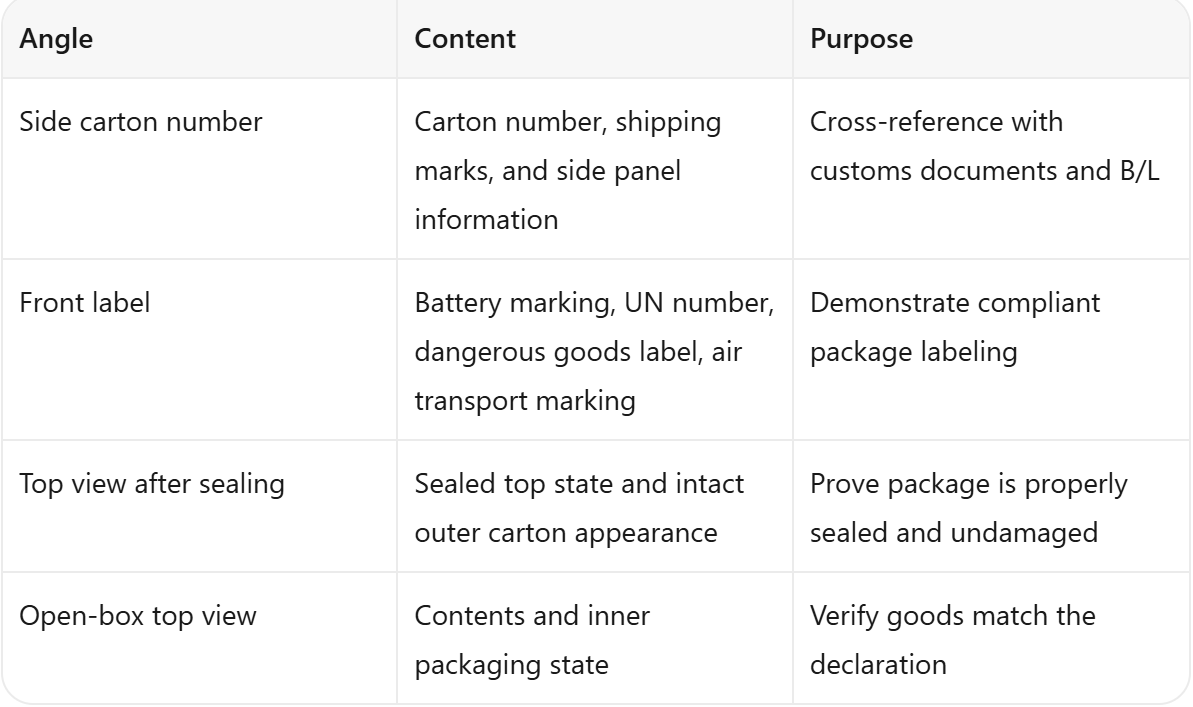
Each mode has its own emphasis — 9610 leans on parcel appearance and labels, 9710 on carton numbers matching the declaration, 9810 on carton condition matching the packing list. Yet these four angles together cover the documentation priorities of all three modes. In our experience, teams that capture all four angles every time stop guessing "which shots are needed this time" entirely — and that habit pays off across every mode they ship under.
4. A Four-Step Workflow That Standardizes Photo Documentation
Once the angles are set, fix the process in four steps:
Place on the photo station — after packing, put the unsealed carton with its carton-number barcode in the designated spot;
Automatic barcode scanning and top view — the system reads the barcode automatically and takes one photo with the top-view camera;
Button-triggered multi-angle shots after sealing — once sealed, press the button to trigger the preset routine that captures the carton side, front label, sealed top view, and other angles;
Archive by barcode — all photos are automatically filed by carton number, ready for query, export, and submission to forwarders, overseas warehouses, or customs.
5. A Real Scenario: 180 Cartons and 4 Photos That Could Not Be Found
A smart-home accessories exporter shipped a first-leg consignment of more than 180 cartons to a US East Coast warehouse under mode 9810. After inbound, the warehouse reported 4 cartons with damaged outer boxes and asked for the shipping-stage photos of those 4 cartons by carton number. The team searched chat logs and phone albums for nearly an entire afternoon and found only two blurry shots — the cartons looked virtually identical, and no one could confirm which photo belonged to which carton.
The team subsequently switched to a barcode-based archiving workflow: each carton passing the photo station was automatically filed by carton number. The next time verification was needed, they entered the carton number and exported the full set within minutes. Honestly, the difference was not the photography — it was the archiving. The point of this case is not how advanced the equipment is, but a plain fact: the core capability of export documentation is "retrievable by carton number." Photography is only the means; archiving is the key.
6. Why Ordinary Warehouse Surveillance Is Not Enough
Ordinary warehouse cameras mainly record what happens on site and archive footage by camera number and time. They can hardly associate footage with carton numbers automatically, nor produce the standard photo documents required for shipping. The inboz hazmat packaging four-angle photo system focuses on shipping documentation — automatic barcode recognition, button-triggered multi-angle capture, photos archived by barcode, all queryable and exportable for submission; shooting angles and naming rules can be customized to the requirements of forwarders, overseas warehouses, or customs. For specific requirements, contact us to discuss customized development.
However the export mode switches, and whoever ultimately receives the photos, the underlying capability line — identify the carton number, trigger the shots, archive by barcode — stays the same. That is exactly the value of standardizing the documentation process.
FAQ
Q: Can 9610, 9710, and 9810 be used interchangeably?
A: Each shipment should be declared under the supervision mode that matches its actual business form, subject to the official position of the customs broker and the General Administration of Customs. It is common for one seller to ship different batches under different modes — which is precisely why the documentation workflow needs to be mode-agnostic.
Q: How long should photos be retained?
A: For export scenarios, follow the requirements of the forwarder, the overseas warehouse, and the local customs authority, subject to the latest official announcements. The longer the retention period, the more the organization of storage and archiving matters — and the more obvious the advantage of barcode-based archiving becomes.
Q: Are phone photos plus a shared cloud drive good enough?
A: For small trial orders, they can barely work, but three problems are hard to avoid: inconsistent angles, photos that cannot be matched to carton numbers, and purely manual retrieval. Once volume grows, the last one breaks first — nobody wants to search thousands of photos for 4 specific cartons.
For more export photo-documentation solutions, see the solution page: Customs Inspection Photo Records and Barcode-Recognition Photography Solution.
Originally published by inboz (Guangzhou) Technology Co., Ltd.