
Footwear is a category where the return rate is very hard to push down. Size, fit and colour can each turn a sale into a return. Most merchants are prepared for that. What actually drains resources is not the return figure itself, but the fact that a returned pair of shoes cannot tell its own story — whether the crease on the sole was there from the start or came from a week of wear, whether the parcel contained one shoe or two, whether the shoebox was crushed in transit or opened carelessly by the buyer. This article explains how to build shipping traceability for footwear: equipment structure, standard actions, return-side evidence, and deployment order.
1. Which Return Costs Are Manageable and Which Are Not
Let me start with a conclusion I have become increasingly confident about in practice: a high return rate in footwear is largely a product-attribute outcome. Size deviation, the gap between fit and photos, screen colour differences, personal comfort preferences — these are predictable returns. Budget for them, fund the reverse logistics, and they can be managed.
The part that runs out of control is different. The amounts are usually small, but each case requires staff time, cross-department checks, and may leave a dispute record on the store backend that affects service metrics.
A women's footwear team ran the numbers: an average order value of around three hundred yuan, sixty to seventy orders a day, and a return rate of roughly thirty percent year-round. Last autumn a buyer requested a refund on the grounds that "only one left shoe arrived." Three warehouse staff spent two days checking outbound records, weighing data and courier receipts. Every step of the process matched, yet none of it could prove that two shoes had been in the parcel. Three hundred yuan was refunded. The supervisor's words: "It's not the money. It's the frustration."
These cases fail for the same reason: not a lack of justification, but a lack of evidence.
If every order had left behind a shipping recording that clearly showed the two shoes, the size label and the accessories, the same case would have taken about ten minutes instead of two days.
2. Three Specific Difficulties in Footwear Evidence
Evidence challenges differ by category. Jewellery fears swapping, 3C accessories fear missing parts, and footwear is messier. All three difficulties below concern what to capture, not how much the equipment costs.
Difficulty one: the unique identifier is buried. The article number, size and colour — the information that ties an item to its identity — is usually printed on the inner label of the tongue or the side of the shoebox. No matter how sharp a front-facing photo is, it will not capture them. This is why swap disputes are the hardest to win in footwear: a buyer returns an old pair of the same model from a different year, and appearance alone cannot tell them apart.
Difficulty two: a pair is a two-piece item. Photographing one shoe is the same as photographing nothing. One shoe missing, two shoes of different sizes, two shoes of different colours — all three have genuinely happened. In an overhead frame, placing both shoes side by side is the simplest safeguard.
Difficulty three: the shoebox is both packaging and product. A crushed corner, dampness, a torn factory seal — a single sentence about "affecting resale" is enough to justify a return.
The shoebox condition has to stay in frame during packing.
One more action that is widely overlooked: the outsole. Turning both shoes over for one shot costs less than a second, yet in any dispute over whether a pair has been worn, it carries more weight than ten photos of the uppers. I have watched complete packing workflows in many warehouses, and most do not include it.
3. Deploying Packing Monitoring and the Footwear Standard Workflow
On the equipment side, e-commerce packing monitoring uses a dual-camera structure at the packing table: an overhead camera mounted directly above the table acts as the scene camera and covers the whole process from product placement to sealing; a label close-up camera aimed at the shipping label captures the tracking number clearly.
The recording mechanism is the most misunderstood part. It is neither a scan-to-bind step nor dependent on anyone pressing a button — the label is placed under the close-up camera, the system recognises the tracking number and recording starts automatically; when the label is picked up, recording stops automatically. The whole clip is bound to that tracking number, which corresponds to an e-commerce order, creating an indirect link between footage and order. To retrieve a specific shipment later, enter the tracking number and the clip is located in seconds.
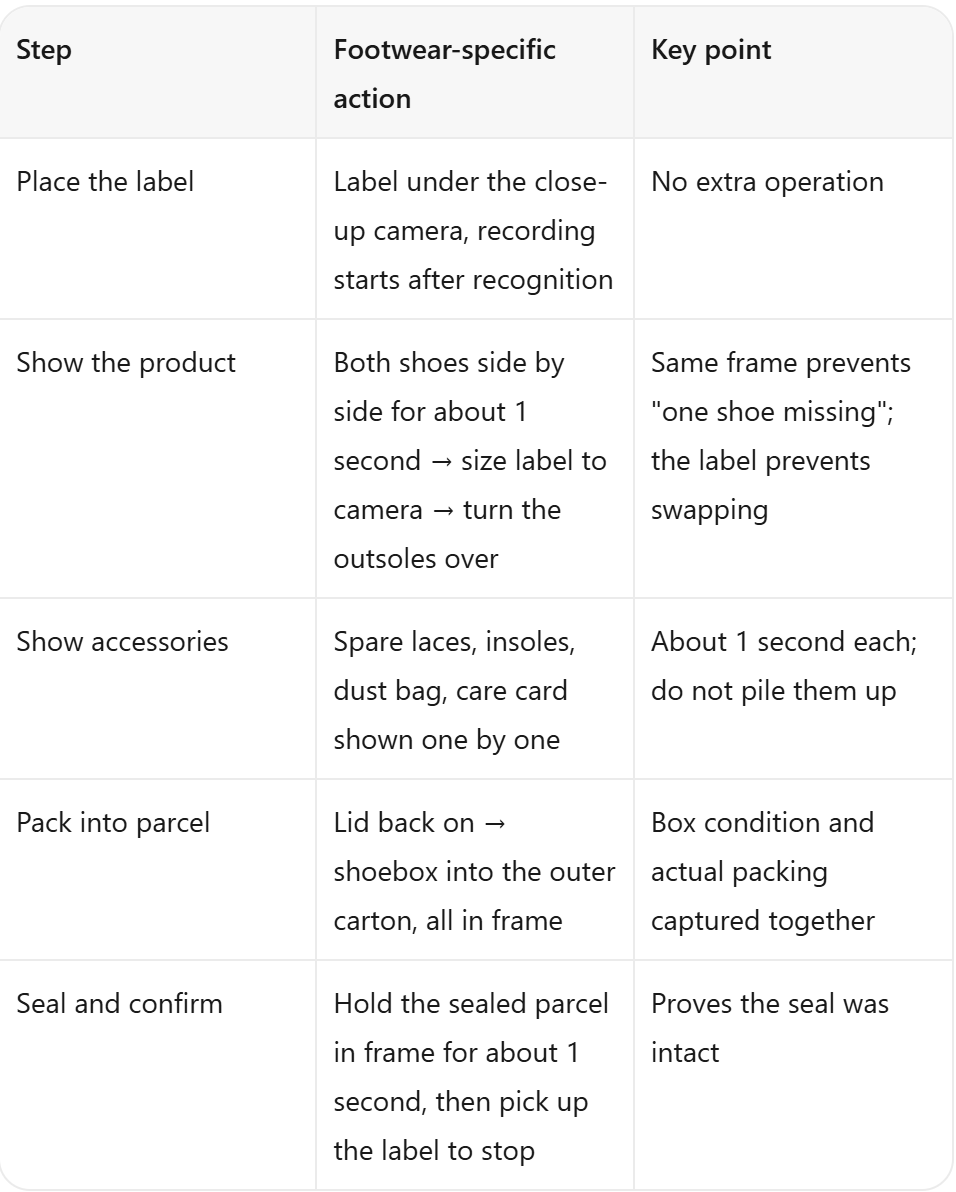
The standard workflow remains five steps.
For footwear it needs adjusting to the product's own characteristics; the version below is what I recommend in practice.
ded now.
During recording the system automatically captures key frames according to preset rules, and manual capture is also available. Every photo carries the corresponding tracking number and timestamp. For any selected order, all photos and timestamps can be exported in one click as an evidence package ready to submit to the platform.
Here is a detail I repeat to every client: platform agents have no time to watch a full video. A screenshot package arranged along a timeline is accepted far faster than a ten-minute recording. For footwear in particular, the size label, both shoes in one frame, the outsoles, the accessories and the sealed parcel tell the whole story in five images — no one needs to watch ten minutes.
4. The Return Side: Unboxing Evidence Is Underestimated
Many merchants put the entire budget on the outbound side and leave the returns area empty.
At a thirty percent return rate, I think that allocation is unbalanced.
A thirty percent return rate means a large volume of returned parcels arrives every day: some genuinely do not fit, some have been worn for a week, some are old pairs of the same model. Who opened the parcel, in what condition, and what was found inside — that record is worth no less than the outbound footage. Adding a camera in the returns processing area to record the entire unboxing process, then comparing it side by side with the outbound footage, makes it immediately clear whether the size label matches, whether the outsoles are worn, and whether the accessories are complete.
One children's footwear team resolved a swap dispute exactly this way: the returned pair carried the same article number and the label matched, but the mud in the outsole tread did not match the clean outsole in the outbound footage, and the buyer withdrew the claim.
One clarification: the system does not provide automatic statistics. Error rates and missing-part rates still require manual analysis of recordings — but because evidence is archived by tracking number, retrieval is far faster than scrubbing through surveillance footage frame by frame.
5. Retention, Storage and Deployment Order
We recommend retaining footage for at least 90 days to cover the platform after-sales appeal cycle; for designer or imported footwear with higher order values, 180 days or more. Storage can be estimated as "daily orders × average 2 minutes per order × retention days." Multi-station warehouses do not need to check each device separately — packing stations on the same LAN can be queried in a unified console. The system does not require replacing the existing ERP; as long as the tracking number on the label can be recognised, it works alongside it.
The test for deploying packing monitoring is simple: can the loss from a single dispute exceed the cost of one equipment set? Footwear, apparel and bags rank second in dispute risk, just behind jewellery — not because the unit price is highest, but because size, appearance and accessory disputes occur so frequently.
A sensible deployment order: cover the outbound packing table first, then add the returns unboxing camera, and finally set the retention period by order value. Do not chase whole-warehouse coverage at the start; the budget spreads thin and the effect is hard to see.
Settle this calculation before the next seasonal launch.
6. FAQ
Q: Are appearance photos not enough? Do we really need the size label?
A: Appearance photos prove condition but not identity. A swap dispute hinges on "is this the pair I shipped," and only the article number, size and colour can answer that. They are usually on the inner tongue label or the shoebox side label, so they need a dedicated close-up.
Q: With a thirty percent return rate, will photographing every order slow down dispatch?
A: Recording starts and stops automatically, and each display point takes about one second. The existing actions — opening the box, verifying the code, adding accessories, closing the lid — are unchanged, so the added time is minimal.
Q: Should the shoebox be photographed as well?
A: Yes. The shoebox is part of the product. Keeping its condition in frame during packing allows you to distinguish a pre-existing defect from damage caused in transit or during unpacking.
Q: Do we need to replace our current ERP?
A: No. As long as the tracking number on the label can be recognised, the system works alongside your existing ERP and order systems.
Closing
The difficulty in footwear shipping traceability is not the equipment; it is working out which frames will actually be useful in a dispute. The size label, both shoes in one frame, the outsoles, the accessories and the sealed parcel cover the vast majority of footwear return disputes. Decide what to capture first, then decide what to install.
This article was originally published by inboz (Guangzhou) Technology Co., Ltd. For more details on the equipment structure, recording mechanism and retention options of e-commerce packing monitoring, please visit the inboz.cn solution pages.