
Fresh produce is one of the few e-commerce categories where the return rate may be modest but the dispute value is not. A carton of cherries travels for two days; on the third day after delivery the buyer reports that the whole box has gone soft and bitter, and asks for a full refund plus compensation. At that point the merchant usually holds only a picking list and a courier receipt — documents that prove the goods were dispatched and delivered, but not what the fruit's firmness and stem colour were at the moment it was sealed into the carton. This article discusses dispatch-side evidence for fresh produce: why attribution fails, which frames need to be captured, how the five standard actions should be rewritten for the category, and how retention periods should actually be calculated.
1. Why Fresh Produce Disputes Fail: Condition Cannot Be Traced Back
In warehouse and fulfilment work, fresh produce has a reputation as the hardest category to argue. Frankly, I started out applying ordinary-goods logic here myself, and it took a few hard lessons to change course.
For ordinary goods the dispute centres on whether the item was there and whether it was the right one. Missing parts, wrong dispatch, swapped returns — these are static facts, and one recording settles them. Fresh produce is different. The argument is about when the goods went bad, and spoilage happens every day. It does not wait for the merchant to prepare.
A carton of leafy greens off the cold chain changes by the day. When a claim arrives on the third day, at least two explanations exist: the condition was already compromised at dispatch, or the parcel was not refrigerated after delivery. The liability differs entirely, yet without footage from dispatch the merchant is not even in a position to argue.
Fresh produce does not respond to process compliance alone.
One importer of cherries had a textbook case. In February this year, an order with an average value of RMB 168 was reported on the third day as soft and bitter, with a refund plus compensation requested. The packing recording showed three layers of fruit, each rotated once towards the camera, stems still green, and two ice packs squeezed by hand that were hard enough to hear. The arrival photos uploaded by the buyer showed ice packs at the bottom of the foam box already collapsed and the absorbent paper bone dry. The platform awarded a partial refund covering RMB 20 of shipping. The owner's comment: "What was worth something was finally knowing which step we had got right."
The previous year the same team shipped lychees with no recording at all. One order worth RMB 298 was refunded in full. The reason given was a single sentence: it could not be proven.
2. Three Specific Difficulties in Fresh Produce Evidence
Difficulty one: condition degrades. Fruit straight off the tree and fruit three days old differ completely in colour, sheen and firmness. The dispatch footage therefore has to show what fresh looks like, and do so with identifiable detail: stem colour, surface sheen, any bruising. None of this is legible in a wide-angle frame, which is why we do not accept ceiling-mounted surveillance as an evidence instrument.
Difficulty two: the ice pack is the only attributable preservation evidence. When a buyer says the ice had melted, can the merchant prove how many packs were packed, whether they were frozen solid, and which layer they sat in? I have seen plenty of warehouses drop the ice packs on top of the carton with the fruit smothering underneath. The moment that placement is in the frame, responsibility becomes clear. This is the easiest gap to close and the one most often overlooked.
Difficulty three: counting in fresh produce is awkward. With thirty apples in a carton, two short and three bruised, no customer will count them out for the merchant. Only the packing action itself can prove a full carton: layer-by-layer display, layer-by-layer refilling, then sealing, every layer passing the camera once.
All three point to the same requirement: the frame must capture condition, not merely objects.
3. Adapting the Five Standard Actions
The equipment structure is unchanged. The packing table uses a dual-camera arrangement: an overhead camera mounted directly above the tabletop acts as the scene camera, covering the whole process from product placement to sealing; a label close-up camera aimed at the shipping label captures the tracking number clearly. A separate unboxing camera can be added in the returns area.
The recording mechanism is the most misunderstood part: no scanning, no manual button. The label is placed under the close-up camera, the system recognises the tracking number and recording starts automatically; when the label is lifted, recording stops. The clip is bound to that number, the number corresponds to an e-commerce order, and the footage is thereby linked to the order indirectly. Retrieval is a matter of entering the number.
The standard workflow remains five actions. For fresh produce it needs adjusting to the category; the version below is what we run in the field.
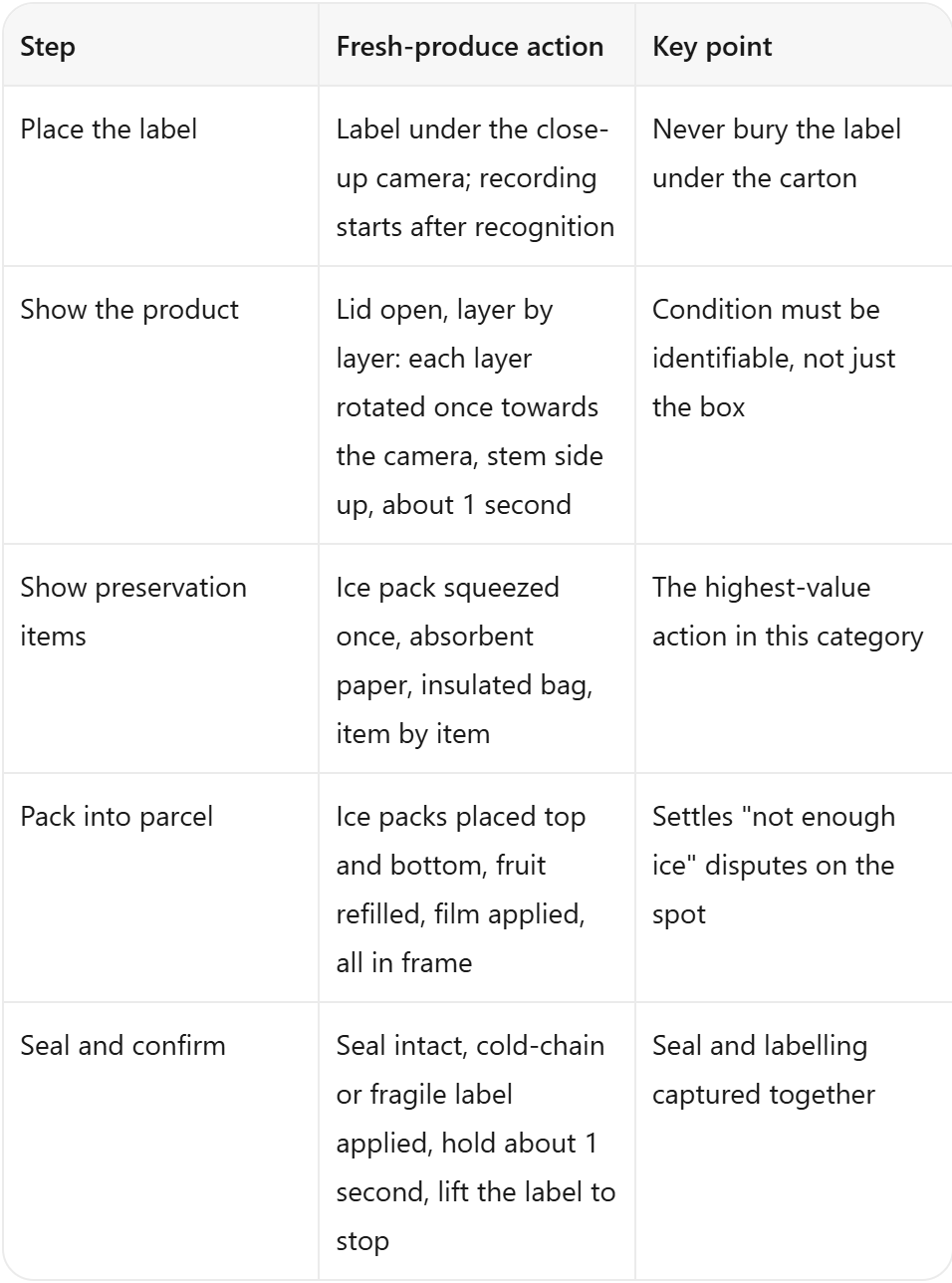
That squeeze in row three looks redundant to many warehouses. I take the opposite view — it costs one second and turns "the ice was frozen solid" from an assertion into a verifiable image.
One optional action has nothing to do with the system: after sealing, place the carton on the tabletop scale and let the weight figure enter the frame. Fresh produce sells by weight, and a short-weight dispute disappears with that one shot, provided the scale sits inside the overhead camera's coverage.
Packer resistance is the most common internal objection, and the real added time is one second per display point. During recording the system captures key frames automatically according to preset rules and also supports manual capture; every photo carries its tracking number and timestamp and can be exported in one click.
For fresh produce we recommend locking the evidence package to a fixed sequence: label with timestamp, layer-by-layer fruit condition, ice pack squeeze, layered packing, sealed parcel with cold-chain label.
Sequence matters more than volume. Platform agents will not watch ten minutes of video; five frames arranged along a timeline can be reviewed in thirty seconds.
4. Where the Unboxing Camera Ranks
Here is a judgement that departs from our usual advice.
Many colleagues disagree, but we have held this order for two years.
For most categories we recommend deploying an unboxing camera in the returns area at the same time. For fresh produce we rank it second. The reason is practical: a substantial share of fresh-produce disputes are refund-only, with no goods returned, because perishable items are pointless to ship back. The budget order should therefore be reversed — get the dispatch side right first, then add the returns area.
That does not make unboxing evidence unimportant. When a full carton is refused and returned, whether the damage happened in transit or existed at dispatch is settled by recording the unboxing and comparing it with the dispatch footage. Returned disputed items work the same way: the condition at opening, and which layer the damage sits in, are all on continuous record.
Unboxing and recording the moment a return arrives is something we have stressed for other categories; for fresh produce it must be faster. One day's delay and the condition has moved another step, and the evidence has depreciated.
5. Retention, Storage and the Deployment Decision
We recommend retaining footage for at least 90 days to cover the platform after-sales appeal cycle. For seasonal items such as hairy crab, lychee and cherries, keep at least 30 days beyond the end of the season so cross-season tracing remains possible; gift-boxed products with higher order values warrant 180 days or more. Storage can be estimated as daily orders × 2 minutes per order × retention days. Multiple packing stations on the same LAN can be queried in one console, and the system does not require replacing the existing ERP — as long as the tracking number on the label can be recognised.
One calculation error is common: because the fresh-produce after-sales window is short, many merchants assume 30 days of retention is enough, and only discover the footage has been overwritten when a cross-season claim arrives. Seasonal retention should be counted back from the end of the season, not from the after-sales window.
Note also that the system does not provide automatic statistics. Refund and damage rates still require manual review of recordings, though retrieval by tracking number is far faster than scanning frame by frame.
The deployment test remains simple: can the loss from a single dispute exceed the cost of one equipment set? In fresh produce the arithmetic closes quickly — a gift box sells for two to three hundred yuan, and a handful of full refunds in one season settles the account.
Back to the opening question: the answer splits in two. Recorded and recorded correctly, the footage saves you — label, fruit condition, ice packs, packing, seal all in frame form a complete evidence chain, and most disputes are settled at that step. Recorded but recorded wrongly, it saves nothing: a box exterior, a blurred wide-angle view, a handful of fragments detached from any timeline are barely better than nothing, and sometimes worse, because the merchant believes evidence exists until the appeal reveals it does not.
I have stood in that particular hole myself, on a client site.
Closing
The difficulty in fresh-produce evidence is not the equipment; it is working out which frames will actually be useful in a dispute. Fruit condition, ice packs, layered packing and seal status, together with the label timestamp, cover most spoilage claims. Decide what to capture first, then decide what to install.
This article was originally published by inboz (Guangzhou) Technology Co., Ltd. For more on the equipment structure, recording mechanism and retention options of e-commerce packing monitoring, please visit the relevant solution pages on inboz.cn.