
When freight forwarders, airlines, or customs ask for photos of dangerous goods cartons, the core purpose is to verify the UN number and related markings against shipping documents. This article breaks down the five details every label photo must capture, the four most common reasons photos get rejected, and how to turn photo documentation into a fixed workflow. Regulatory details are subject to the latest official announcements from China Customs, IATA, and other authorities.
1. The UN Number: The Identity Code of Dangerous Goods Exports
A UN number is an identification code assigned by the United Nations Committee of Experts on the Transport of Dangerous Goods. It consists of "UN" plus four digits, with each number corresponding to a specific substance or item. Across the export process — customs declarations, dangerous goods packaging certificates, manifests, and carton labels — the same numbering system is used.
This defines the first purpose of a carton photo: consistency verification. What forwarders and customs officers check is not whether a photo "looks good," but whether the UN number and proper shipping name in the photo match the declaration documents. A sharp photo with a mismatched number is just as unusable as a blurry one.
Two common examples: UN3480 (lithium-ion batteries) and UN3082 (Class 9 miscellaneous dangerous substances, a category where water-treatment chemicals and various industrial products often fall). Note that the classification and proper shipping name of any specific substance must follow the latest official announcements and the shipper's own test report and packaging certificate — do not copy a carton label from a competitor.
2. Five Details Every Photo Must Capture
Based on the practical requirements of forwarder verification and customs spot checks, a compliant carton photo should include at least the following five details:
1. The UN number itself. "UN" plus four digits, fully legible, with no glare or obstruction. Most labels have a laminated surface that reflects light when shot head-on — the most common reason for rejection.
2. The proper shipping name. The product name next to the number must be in frame. The number and the name must "match," which is also the basis for cross-checking against declaration documents.
3. The class label. The diamond-shaped hazard class label must be fully visible, with its color and pattern distinguishable — the diagonal stripes of Class 9, the black-and-white halves of Class 8. A washed-out label stalls both automated and manual review.
4. The packaging mark string. The packaging specification code on the carton (subject to the packaging certificate and official announcements) is small text, but capturing it clearly can save a round of "close-up follow-up photos," especially in scenarios with online verification.
5. Positional context. Which face of the carton the label is on, whether it is damaged or overlapping with other labels — ideally with the carton number in the same frame. In practice, photos get rejected more often for "not matching" than for "not being sharp." The person taking the photo rarely knows there is a per-carton matching step downstream.
Of the five, the first four solve "is it clear," while the fifth solves "does it match." In our experience working with exporters, most teams focus entirely on the former — yet what actually causes full-batch reshoots is usually the latter.
3. A Case: Shrink-Wrap Glare and a Label Separated from Its Box Number
In late 2025, a water-treatment chemical plant in South China exported a batch of Class 8 corrosive goods. The forwarder requested carton label photos as usual. Warehouse staff submitted three casually taken photos, and the entire batch was rejected — two details were at fault. First, the cartons were wrapped in transparent shrink film; shot head-on, the label reflected glare and the two middle digits of the number became unreadable. Second, the label was on the front face while the carton number was stenciled on the side, so none of the three photos showed both the number and the box code together.
The forwarder needed to match each photo against the declaration documents carton by carton. The photos with blurred numbers could not be verified; the verifiable ones lacked the box number. The warehouse spent three days re-unpacking, peeling film, and reshooting, missed the original vessel, and slipped to the next sailing. The total cost of that delay exceeded three months of a packer's wages.
Afterwards, the factory wrote three rules into the packing-station instructions:
Peel back a corner of the shrink film before shooting, number area facing the lens;
Number, shipping name, and class label fully in frame;
Every label photo must include the carton number, so each carton can be matched individually.
The method is simple. What matters is closing the information gap — the photographer never knew what the photos would be used for. The shot itself takes ten seconds, but every angle and detail chosen reflects downstream verification requirements. In our view, that gap is the cheapest thing to fix and the most often ignored.
4. The Four Most Common Reasons Photos Get Rejected
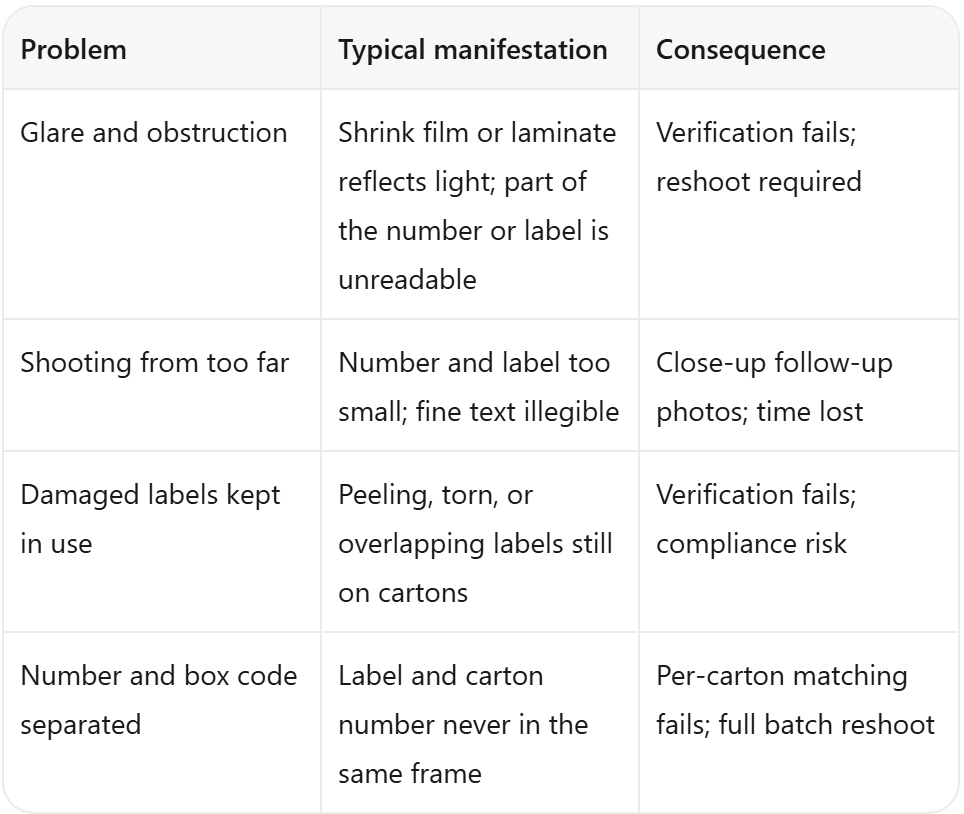
The fourth item deserves the most attention. The first three are shooting-quality issues, fixable by habit change. The fourth is an archiving problem — photos scattered across phone albums, never tied to carton numbers, impossible to find or match when problems arise.
5. Casual Phone Shots vs. a Standardized Documentation Workflow
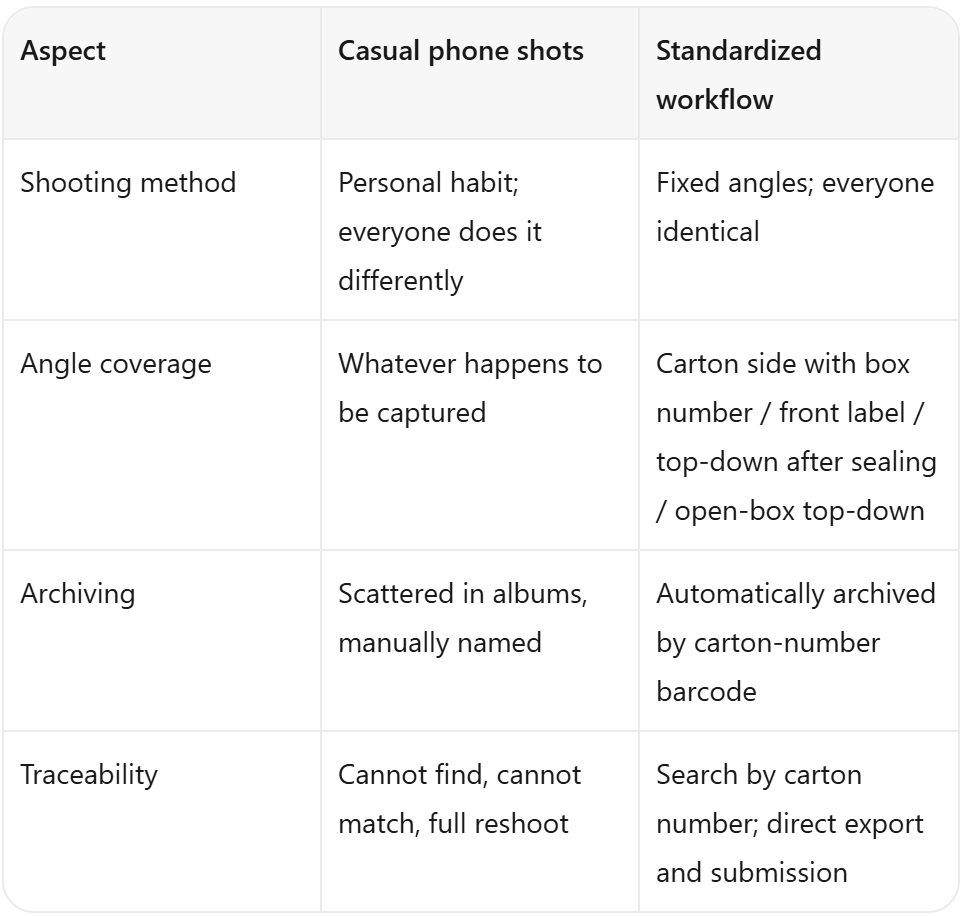
A standardized workflow has four steps: the unsealed carton is placed at a designated spot on the photo station; the system automatically recognizes the carton-number barcode and triggers an overhead shot; after sealing, a button triggers a preset sequence that automatically captures multiple angles — the carton side with box number, the front label, the top-down view after sealing. The UN number and hazard labels fall under the "front label" angle. All photos are archived by barcode, ready to be searched and exported by carton number for submission to forwarders, airlines, or customs for record-keeping.
Ordinary warehouse CCTV records the scene but makes it hard to archive by carton number, and cannot directly produce the standard photo materials forwarders need. The inboz hazmat packaging four-angle photo system focuses on shipping documentation: recognizing carton numbers, triggering multi-angle shooting at the press of a button, and archiving photos by barcode for querying, exporting, and submission. Shooting angles and naming rules can be customized to the requirements of forwarders, airlines, or customs — contact us to discuss your specific needs.
6. Regulatory Context: Image Records Are Becoming Mandatory Declaration Fields
Since 2026, customs supervision of lithium battery and other dangerous goods exports has tightened markedly: continued crackdowns on mis-declaration, concealment, and exports without dangerous goods packaging certificates, alongside the "Single Window — Export Lithium Battery Packaging" system, which makes image data a mandatory declaration field requiring uploads of dangerous goods transport label images, liner images, images of installed batteries, and images of the packaging's outer faces (with label markings) — at least four images.
In parallel, multiple local customs offices are piloting "smart supervision" of export lithium battery packaging: enterprises upload images of packaging exteriors, sealing, UN markings, warning labels, and storage, and customs performs online verification using AI image recognition and parameter comparison — no anomaly means no on-site inspection; anomalies are escalated to manual review. Images and system records must be retained for more than 2 years per local customs requirements.
One clarification: the industry phrase "shoot 4 photos" is not a regulation requiring four photos per carton before shipment. It is a shorthand for the combined image-documentation actions of declaration uploads plus daily container-loading records (outer boxes, labels, liners, sealing, palletizing, container loading). When relaying this internally, keep the wording accurate; specific requirements follow the latest official announcements from the General Administration of Customs and local customs offices.
7. FAQ
Q: The label is damaged but the shipment is urgent — can we ship first and fix it later?
A: Not recommended. A damaged label is an obvious defect in verification, and the cost of rejection far exceeds replacing the label. Label condition should be a pre-packing check item.
Q: How long should photos be retained?
A: Per local customs requirements, production images and system records should be retained for more than 2 years. Voluntary retention should be no shorter than that; follow local customs guidance for specifics.
Q: What is the authoritative source for UN numbers and shipping names?
A: The cargo's test report, the dangerous goods packaging certificate, and the latest official announcements. When classification is uncertain: test first, label second, photograph last — the order must not be reversed.
Conclusion
Photo documentation for dangerous goods exports is, at its core, about making number consistency real: every photo matches the declaration documents and the carton number, and every required detail is verifiable. Turn the five must-capture details into a checklist at the photo station, replace personal habit with a fixed workflow, and rejection rates and shipping delays will fall noticeably — we have seen this hold up across dozens of export warehouses. Where regulations are updated, the latest official announcements from China Customs, IATA, and other authorities prevail.
Originally published by inboz (Guangzhou) Technology Co., Ltd.