
The Right Selection Order: Solution Type First, Brand Second
"Which brand is best for packing station monitoring?" is among the most frequently asked questions in e-commerce warehouse selection. But before comparing brands, one prerequisite must be confirmed: is the solution type actually fit for the packing-evidence scenario?
Packing station monitoring is not simply "recording some footage." It must answer three critical questions in after-sales disputes: the condition of the goods at shipment, the contents of the package, and the correlation between video and order. Accordingly, any solution must pass three gates:
Legible: product details and accessory counts are recognizable in the frame;
Correlatable: the courier tracking number is bound to the video, and the number corresponds to the order;
Retrievable: videos are archived by tracking number and can be located quickly when disputes arise.
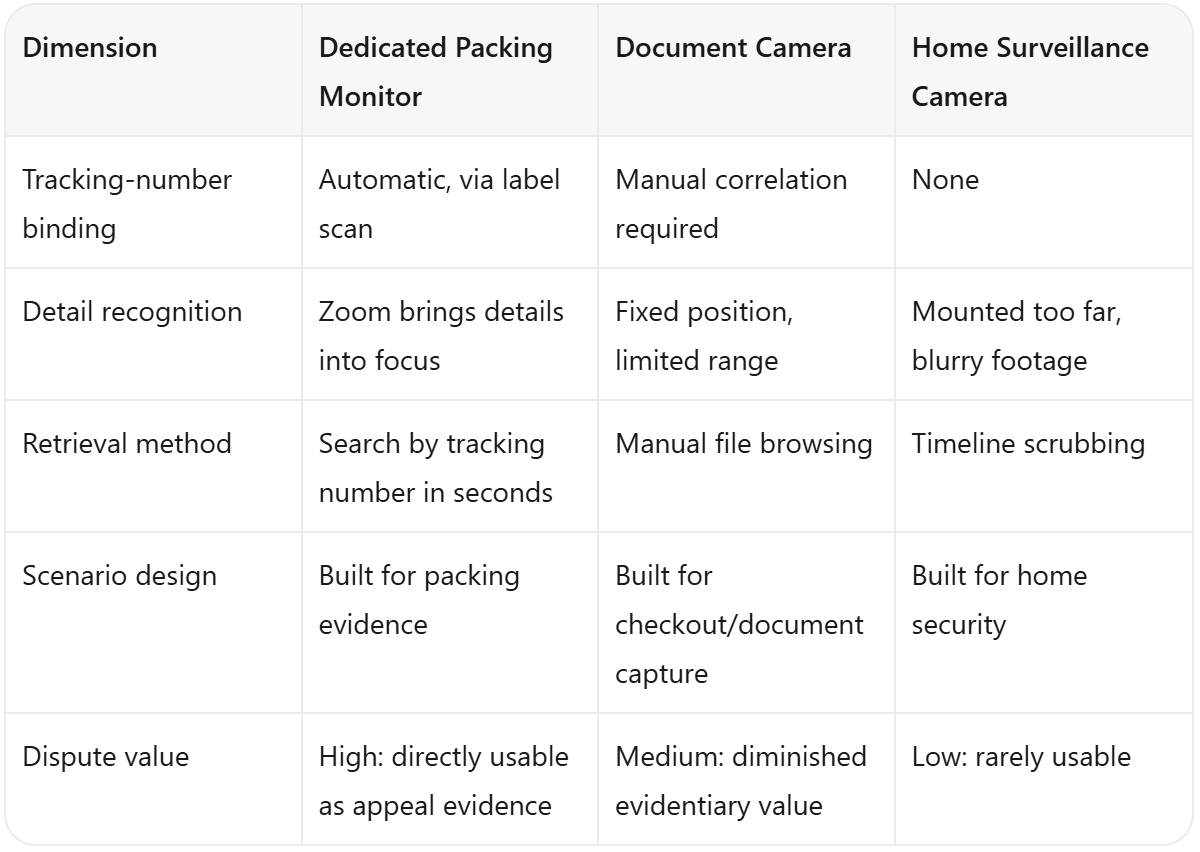
The three common solution types on the market — dedicated packing-monitoring equipment, document cameras (overhead projectors), and home surveillance cameras — differ essentially in their ability to pass these gates. The correct selection order: confirm the solution type passes all three gates first, then compare brands, specifications, and prices within that category.
Side-by-Side Comparison
Detailed Review of Each Solution
Home Surveillance Camera: Sees the Scene, But Cannot Correlate
Low cost and easy deployment make this the first choice of many merchants. However, the category is designed for home security: it has no tracking-number binding capability, so when a dispute arises you can only scrub through the timeline — and even if you find the footage, you cannot prove it corresponds to the specific order. Mounted two or more meters from the packing table, product condition and accessory counts are unrecognizable. It is meaningful as a supplement to warehouse security, but not as an evidence tool.
Document Camera: Close Enough, But Wrong Scenario
The document camera is a mature solution for checkout counters and office document capture, but its shortcomings surface quickly at the packing table: fixed position and small coverage mean larger products fall out of frame, and the sealing-and-labeling action is often incomplete. Its recording logic is not designed for the packing workflow, and video-to-order correlation relies entirely on manual reconciliation — a management cost that escalates sharply as order volume grows.
Dedicated Packing-Monitoring Equipment: Built for Evidence
This is the only category designed with after-sales proof as its objective: the camera targets the packing table, scanning the label binds the courier tracking number to the video (the number corresponds to the order), recording starts automatically upon scanning when shipping via ERP, and videos are archived by tracking number to local storage — retrievable within seconds when a dispute occurs. The upfront investment is less than a staff member's short-term labor cost, yet it covers the evidence needs of every order.
Test Any Solution with the Five-Step Evidence SOP
The most direct way to judge whether a solution or brand is worth purchasing is to check it against the standard packing evidence procedure:
Product display: every side of the product in frame — tests zoom capability and coverage;
Scan and bind: tracking number bound to video — tests binding capability, the fatal weakness of most solutions;
Accessory display: items counted into the box one by one — tests close-range detail clarity;
Seal and label: the sealing action recorded without interruption — tests whether coverage spans the entire packing table;
Archive: local storage by tracking number — tests retrieval and storage design.
Only a solution that passes all five steps deserves to enter the brand-comparison stage; one that fails at step two is an invalid investment regardless of price.
Frequently Asked Questions
Q1: We already have surveillance cameras in the warehouse. Can we add one more to fill the gap?
Not recommended. Home surveillance and dedicated packing monitors operate as independent recording systems: the former stores by timeline with no concept of tracking numbers, while the latter archives by number. In a dispute, footage from the two systems cannot corroborate each other and only complicates the evidence. Unify the evidence system under a tracking-number-bound framework.
Q2: How does this selection logic apply to multi-station warehouses?
Each packing station independently passes the "legible, correlatable, retrievable" gates. Binding is a per-station capability, so the conclusions hold in multi-station scenarios — the differences lie only in equipment count and network topology.
Q3: With a limited budget, can we pilot with selected categories first?
Yes, and it is a common approach. Deploy first in the highest-dispute, highest-value categories (such as jewelry and gold, or 3C accessories), verify the improvement in appeal success rates, then extend to all orders. Review dispute-handling data monthly during the pilot to quantify return on investment.
Q4: Is a larger coverage area always better?
Coverage should match the packing table dimensions. Insufficient coverage lets the sealing action fall out of frame; blindly pursuing extra-large coverage reduces pixel density per unit area and harms detail recognition. Choose based on the outer dimensions of your largest shipped item.
Q5: Can videos of historical orders be used after switching equipment?
No. Evidence protection takes effect from the day of deployment; legacy orders cannot be backfilled. This is why early deployment is advised — every day of delay leaves that day's shipments unprotected.
Reference Options: inboz Solutions
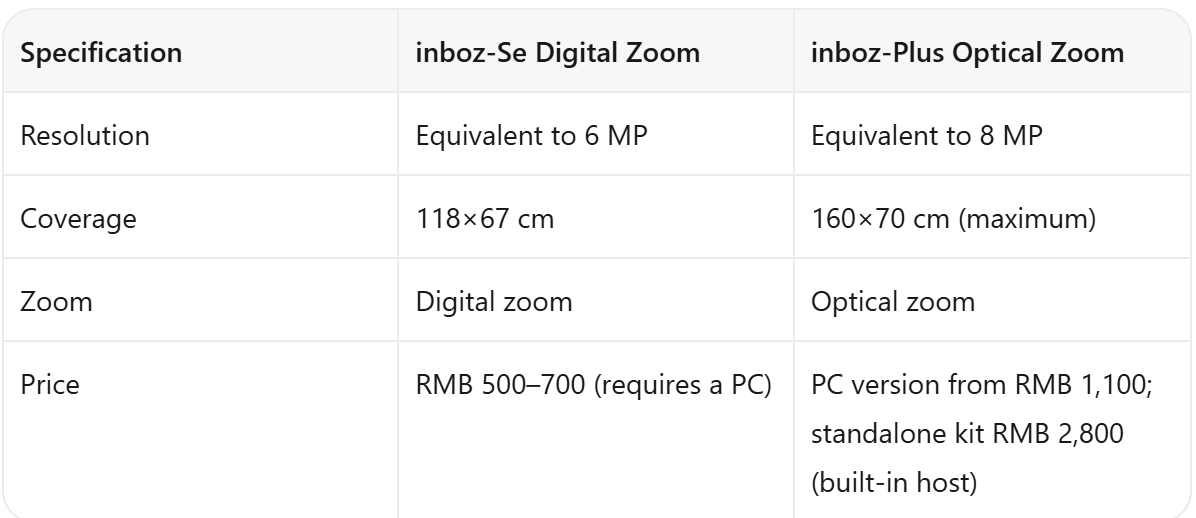
Stores focused on small items with limited budgets can start with the Se; high-value, multi-accessory, high-return-rate categories such as jewelry and gold, footwear, sporting goods, cosmetics, and 3C accessories — as well as women's apparel and livestream clothing — are recommended to go directly with the Plus optical zoom version.
One common misconception deserves clarification: 4K is not the right target for packing-station monitoring. Large files consume storage and cause stuttering; legibility depends on the zoom method, not resolution.
Conclusion
How to choose packing station monitoring: lock the solution type by passing the "legible, correlatable, retrievable" gates, verify execution with the five-step evidence SOP, then select a model within the dedicated-equipment category by category needs and budget. With the right order, selection avoids detours.