
When an e-commerce warehouse team starts looking into packing monitoring, the first question is almost always about price. Comparable devices on the market range from roughly four hundred to over two thousand RMB, and the gap comes down to form factor: PC-connected versions run their recording software on a workstation computer, while standalone kits ship with their own host unit and work right out of the box. This article breaks down the real differences between the two forms and maps them to warehouse conditions, so you can match a budget plan to your actual setup.
What the Price Gap Actually Buys
The core difference between the two forms is not imaging capability — it is the operating environment.
PC-connected devices plug into a computer at the packing station. The recording software runs alongside your everyday shipping-label and order software. For warehouses that already have a computer next to the packing table, this is the lowest-cost deployment: nothing extra to purchase. Among the current lineup, the inboz-Se digital zoom version is priced at 400–700 RMB, and the PC-connected inboz-Plus at 1000+ RMB.
Standalone kits come with a built-in host unit. Plug in, power on, and the system runs — no workstation computer required. The inboz-Plus standalone kit is priced at 2000+ RMB. What the extra budget buys is "no computer occupied, no deployment work": you do not need to dedicate a computer to the packing table, install software, or log in every morning. For warehouses with no spare computers or cramped stations, this saves the cost of an entire workstation retrofit.
So the first decision criterion is straightforward: is there a computer at the packing table that can be shared? If yes, the PC-connected version is more economical; if not, go straight to the standalone kit.
Three Hard Specifications That Set the Floor
Beyond form factor, three specifications determine whether a device can actually meet your needs.
First, capture area. The inboz-Se covers 118×67 cm, while the inboz-Plus covers 160×70 cm. Your table size and typical parcel dimensions decide the tier: long down jackets, office chairs, and pool cues exceed the Se's frame and require the Plus; small-item categories such as 3C accessories, jewelry, and cosmetics fit comfortably within the Se. Note that 160×70 cm is the upper limit for a packing-table setup — full-size furniture and large equipment fall outside this approach, so check your typical parcel sizes before choosing.
Second, zoom method. The Se uses digital zoom; the Plus uses optical zoom. Digital zoom crops and enlarges the image: based on a 12-megapixel baseline, 2× zoom leaves about 3 megapixels of effective resolution, 3× leaves about 1.33 megapixels, 5× about 0.48 megapixels, and 10× only about 0.12 megapixels — the higher the magnification, the worse the detail. Optical zoom magnifies physically through the lens, so clarity does not degrade with magnification.
For high-value categories, this difference directly affects evidentiary value. A close-up of the product serial number, weight, or anti-counterfeit code captured at shipping time is decisive evidence in swap-related return disputes; with optical zoom, the packer can pull the detail into legible range without moving the camera. A higher megapixel count on the spec sheet does not mean a clearer enlarged image — the Se's pixel baseline is higher, but its digital zoom loses effective pixels quickly when magnified. This is the core reason jewelry, gold, and 3C categories are recommended the Plus.
Third, computer availability. Beyond whether a computer exists at the station, consider the packer's daily routine: with the PC-connected version, the software starts with the computer each day; the standalone kit powers on independently. Recording performance is identical — the difference lies purely in deployment and operation.
Matching Four Typical Warehouse Profiles
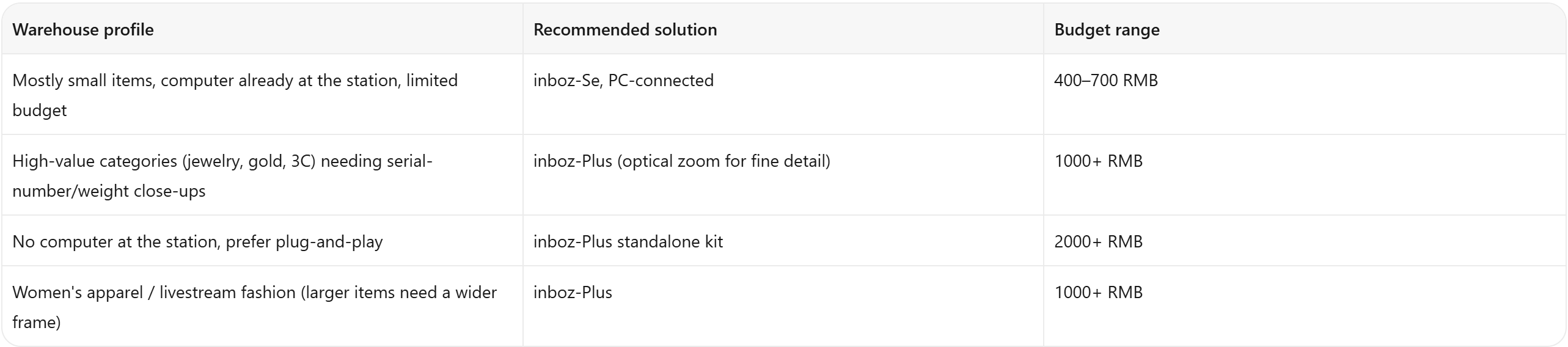
Budget Items Beyond the Device
Two additional items deserve a place in the budget.
Storage. Packing monitoring relies mainly on local storage (hard drives, etc.). Estimate capacity as daily parcel count × average 2 minutes per parcel × retention days. We recommend retaining footage for at least 90 days to cover platform after-sales appeal windows, and 180+ days for high-value categories so that dispute evidence remains complete and retrievable.
Room to scale. When you add packing stations later, multiple stations on the same local network can be queried centrally, and there is no need to replace your existing ERP or order system — as long as the tracking number on the shipping label can be recognized, the system works alongside it. Warehouses on a tight budget can start with one station, validate the workflow, and expand step by step.
Whether the investment is worthwhile comes down to one simple test: if the loss from a single dispute exceeds the cost of one device, it is worth deploying in advance. In jewelry and gold categories, a single swap dispute can involve hundreds of RMB in merchandise value — on par with an entry-level device, meaning one case can cover the cost. For small-item categories, most stores recoup the investment within two months based on monthly dispute volume.
Conclusion
A packing monitoring budget is fundamentally about matching conditions, not chasing price: confirm the computer setup and parcel dimensions first, then choose the zoom method based on whether your category requires close-up evidence, and finally settle the form factor between PC-connected and standalone. Complete these three steps, and the budget lands naturally in the right tier.
FAQ
Q: Do the standalone kit and PC-connected version produce the same evidence?
A: Yes. Both use an overhead camera covering the packing table and a close-up camera that reads the tracking number on the shipping label; recording starts automatically when the label is placed and ends when it is picked up, with each clip bound to its tracking number. The difference is only in how the system runs.
Q: The Se has a higher pixel baseline — why is the Plus recommended for close-ups?
A: Pixel count and zoom method are separate things. The Se's digital zoom crops and enlarges, so effective pixels drop quickly — a serial number becomes hard to read at 5×. The Plus's optical zoom magnifies through the lens, so detail clarity holds at any magnification.
Q: We already have general warehouse surveillance. Do we still need packing monitoring?
A: The two serve different purposes. General surveillance is for security: wide-angle coverage, archived by camera number and time, which means scrubbing through hours of footage to find one order. Packing monitoring mounts over the packing table and archives by tracking number — enter a number and the corresponding packing clip is located in seconds, ready for platform appeals.
Q: How should a multi-station warehouse plan its budget?
A: Start with one station and validate the workflow, then add stations where evidence is needed. Stations on the same local network are queried centrally, and your existing ERP stays in place.