
For air freight exporters, a rejected photo is never just about one image: by the time the photo is reviewed, cartons are usually sealed, palletized, and staged for loading. Re-shooting means re-opening cartons — at best it means resubmitting documents and delayed shipments; at worst, a missed flight. This article breaks down the four most common causes of photo rejection in air shipment documentation, and outlines a standardized photo-retention workflow that export warehouses can adopt for self-inspection before each shipment.
One Rejected Photo Can Hold Up an Entire Shipment
In the air export process, customs, airlines, or freight forwarders may request supporting photos of cartons, labels, sealed boxes, and internal contents. The purpose of these photos is consistent: to use imagery to fix the facts — what the carton is, what it contains, and its sealing condition — for spot checks, customs declaration, and forwarder review.
In practice, manual photography often leads to missed shots, wrong carton numbers, and chaotic photo naming. By the time the reviewer replies "photos rejected, please retake," the goods are usually in a ready-to-ship state. The hidden cost of retaking at that point is high: re-opening cartons requires labor and time, cargo safety carries additional risk, and delivery deadlines are directly exposed to delays.
Photo rejection looks like a photography problem, but the root cause is the absence of standardized photo-retention actions in the shipping process. The following four causes cover the vast majority of rejection scenarios.
Cause 1: Missing Standard Angles — the One Photo the Forwarder Needs Is Absent
The angles commonly required in spot checks and reviews fall into four categories:
Carton side with carton number — capturing the carton number, shipping marks, and side-panel information for cross-checking against customs documents;
Front label — capturing lithium battery marks, UN numbers, dangerous goods labels, and air transport labels;
Top-down view after sealing — capturing the sealed top condition and the intact outer carton;
Open-carton top-down view — capturing the actual contents and packaging condition inside the box, proving the goods match the declaration.
The open-carton view is the one most often missing: once the carton is sealed, there is no natural window to retake it. Another frequent pitfall is misaligned requirements — different forwarders and airlines ask for different angle checklists, and some scenarios require additional palletizing and container-loading photos. Without written confirmation of the checklist before handover, discovering a missing angle mid-way means reworking the entire batch.
Cause 2: Key Information Unclear — Rejected at First Glance
"Unclear" is the most frequent rejection reason, typically in three forms:
Carton numbers and shipping marks blurred by glare or out of focus, making cross-checking against customs documents impossible;
Small text on lithium battery marks and UN labels rendered fuzzy, so reviewers cannot confirm the label contents;
Air transport labels captured only as outlines, without the detail needed for review.
The remedy is simple: face labels squarely toward the lens, avoid direct overhead light, and move the camera close for label details rather than pulling back for a wide shot. The real challenge is consistency — during peak shipping periods, relying on each packer's individual technique makes it hard to guarantee every carton meets the standard. Only a fixed workflow can make pass rates independent of individual performance.
Cause 3: Photos Not Matched to Carton Numbers — the Whole Batch Gets Rejected
In warehouses that rely on mobile phones, photos of hundreds of carton numbers pile up in a camera roll, organized by file names and human memory. When photos get mixed up at submission — say, the front label of carton B sent under carton C — the reviewer's cross-check fails, and the typical response is not rejecting a single photo but rejecting the entire batch for re-review.
For air shipments, the correspondence between photos and carton numbers matters more than photo quality. This is why "filing by carton number" is the first capability to standardize in a photo-retention workflow: once the filing is right, searching, exporting, and submitting become meaningful.
Cause 4: Missing Pre- and Post-Sealing Records — No Way to Retake Them
The top-down view after sealing proves the outer carton is intact and properly sealed; the open-carton view proves the contents match the declaration. Together, they answer the reviewer's core question: "Is this carton the same batch as the one on the declaration?"
The difficulty is the time window: before sealing, the full top condition cannot be captured; after sealing, the interior cannot be photographed. Once the window is missed, retaking requires re-opening cartons — labor cost, cargo risk, and flight schedules all at stake. Retention actions must be embedded in the natural checkpoints around sealing, not patched on afterward.
From Manual Photography to a Standardized Workflow
Comparing manual phone photography with barcode-based automated photography, the gap concentrates in filing and process control:
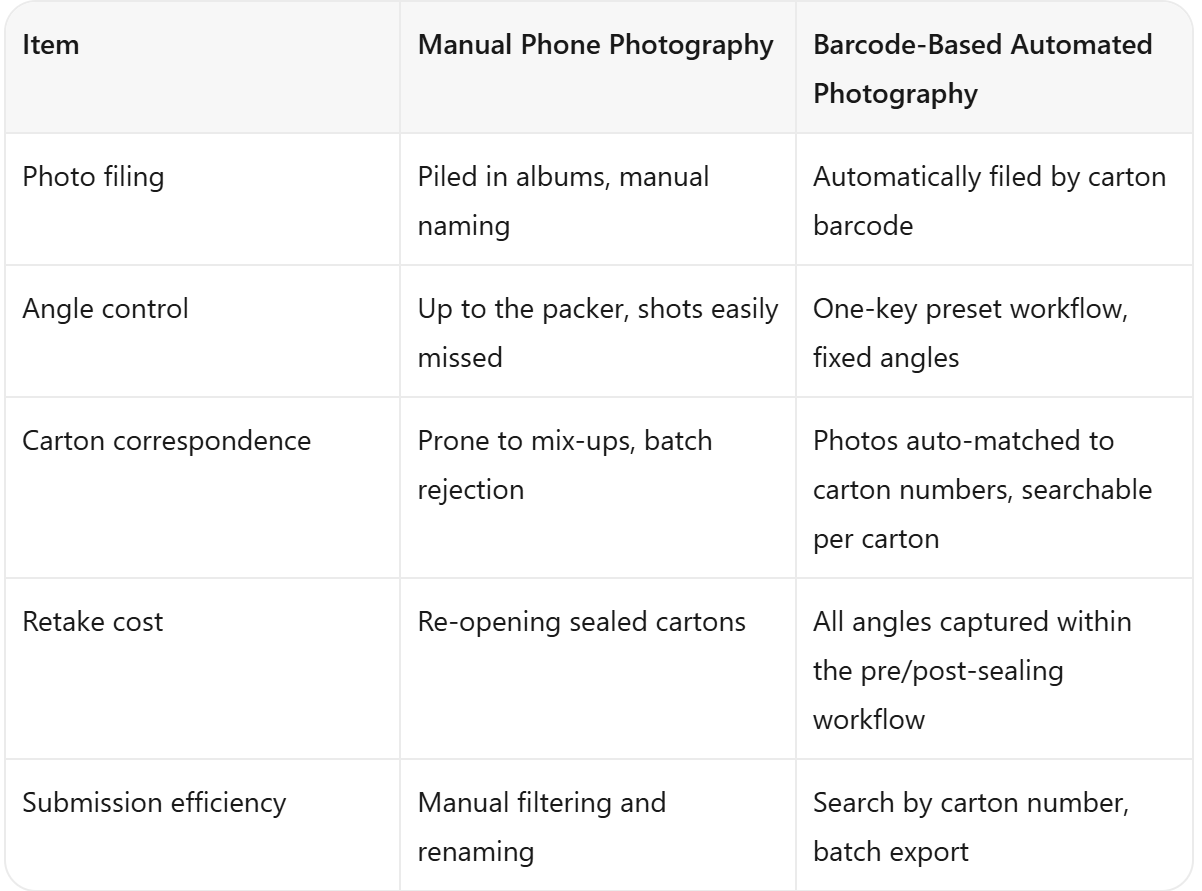
Taking the standard workflow of the inboz hazmat packaging four-angle photo system as an example, four steps close the loop:
Place on the photo station: after packing, place the unsealed carton with its barcode label at the designated position on the station;
Automatic barcode recognition with a top-down shot: the system recognizes the carton barcode and triggers the overhead camera to capture one photo, recording the contents and their arrangement;
One-key multi-angle capture after sealing: once sealed, a single key press triggers the preset workflow, automatically capturing the carton side, front label, sealed top view, and other required angles;
Filing by barcode: all photos are automatically filed under the corresponding carton number, ready to be searched, exported, and submitted to forwarders, airlines, or customs.
Ordinary warehouse cameras mainly record site activity, but rarely file footage by carton number, and are not suited to producing the standard photo materials required for customs or forwarder review. Shipment documentation focuses on the outcome: recognize the barcode, trigger the shots, store multi-angle photos, and file them by carton number — making photos directly available for search, export, and submission. If a forwarder or airline requires specific angles or naming rules, the workflow can be customized accordingly.
FAQ
Q: What if the forwarder's required angles differ from our current practice?
Confirm the angle checklist item by item with the forwarder before shipment, and turn the confirmed list into a fixed photo workflow. Special angle or naming requirements can be handled through customization.
Q: Can rejected photos be retaken afterward?
Post-sealing photos (such as the open-carton view) have no natural retake window; retaking means re-opening cartons, with added cost and risk. Capture all angles within the workflow rather than relying on remediation.
Q: Which teams benefit most from a standardized photo-retention process?
Exporters of battery-powered and lithium battery products, cross-border e-commerce warehouses and self-operated warehouses, teams that submit spot-check photos to forwarders, and any air or sea shipment requiring pre-departure documentation.
Conclusion
Air shipment documentation is not about how well any single photo is taken — it is about whether four things have become process: are the angles complete, is the information legible, do photos match carton numbers, and was the timing window met. Retaining photos at the standard angles required by forwarders and airlines prevents document resubmission and shipment delays caused by missing photos. Flights cannot wait; the process should be in place first.
Where regulations and review requirements are updated, the latest official announcements from the General Administration of Customs of China and the respective airlines and forwarders shall prevail.