
Introduction
Submitting photo documentation for customs inspections is a routine requirement for both cross-border e-commerce sellers and traditional exporters. Yet a common frustration persists: supplementary photos are frequently returned with requests for re-shoots due to incomplete angles, unreadable labels, or missing critical views—causing delays in shipping schedules and additional costs.
This article examines the root causes of photo rejections from the perspective of freight forwarders and customs authorities, presents a practical four-angle photography standard, and outlines an upgrade path from manual photography to automated archiving workflows.
1. Why Photos Get Rejected: Beyond Image Quality
Many exporters initially assume their photos are "clear enough" and wonder why they still get returned. In practice, customs officials and airline carriers require photos that are not merely clear, but also complete and traceable.
Photo rejections typically fall into three categories:
Incomplete angles. Operators often photograph only the front of the package, neglecting the side panel with the carton number, or the top view after sealing. Without these, customs cannot cross-reference the photos with the declaration documents and bill of lading.
Unreadable labels. Critical markings such as UN numbers, dangerous goods labels, and air transport markings may be out of focus, poorly lit, or affected by glare. This issue is especially prevalent in battery and electronics exports.
Missing open-box view. Some inspections require proof that the contents match the declaration. Without an archived top-down view of the opened package, the warehouse must re-open the carton for a new photo—wasting time and potentially compromising packaging integrity.
The underlying cause across all three categories is the absence of a unified photography standard and systematic archiving by carton number. Photos are taken ad-hoc based on operator experience and scattered across personal devices, making retrieval difficult when needed.
2. The Four-Angle Photography Standard
Most freight forwarders and carriers currently accept a standardized approach: photograph each package from four defined angles, and archive all photos under the carton barcode. The four standard angles are:
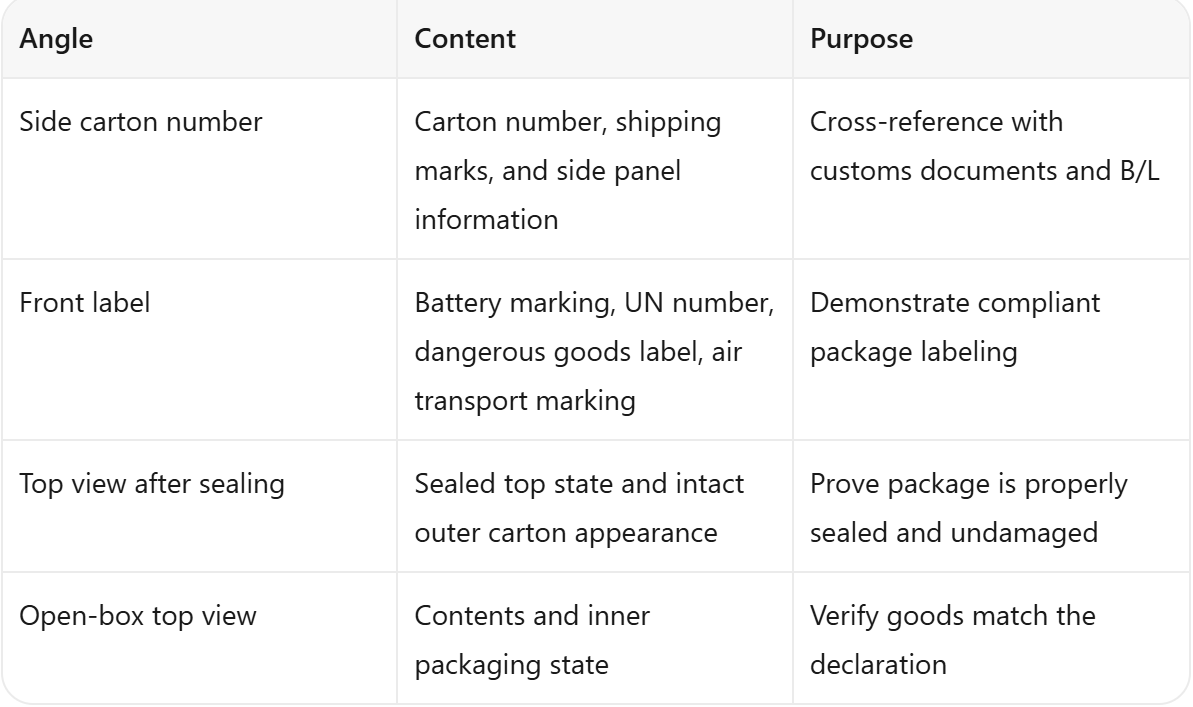
These four angles cover the most common verification requirements in customs inspections and carrier audits. Following this standard significantly reduces the likelihood of resubmission.
In practice, all four angles should be captured at the same photography station to ensure consistent lighting and background. If using mobile phones, a printed checklist posted at the station can help operators verify each angle before completing the session.
3. From Manual Photography to Automated Archiving
Knowing what to photograph is only half the solution. The other half is managing the photos after they are taken.
Manual photography workflows suffer from predictable problems: filenames like IMG_001.jpg provide no link to a specific carton; photos are scattered across multiple phones and computers; retrieving a specific batch requires searching through multiple folders or asking individual operators. At volumes of dozens or hundreds of cartons per day, manual management becomes unsustainable.
A barcode-recognition photography system addresses this through a four-step automated workflow:
Place at the photography station. After packing, place the labeled carton at the designated position on the desk.
Automatic barcode recognition and top-down photo. The system reads the carton barcode and automatically captures a top-down photo, establishing the link between the barcode and the photo set.
Trigger multi-angle capture after sealing. Once sealed, the operator presses a trigger button. The system automatically captures the side carton number, front label, and sealed top view in sequence according to the preset workflow.
Archive by barcode. All photos are automatically filed under the corresponding barcode, enabling instant retrieval by carton number and one-click export of the complete photo set for submission to freight forwarders, airlines, or customs.
The core value of this workflow is that every package's photos carry a unique identifier, eliminating mix-ups; multi-angle capture is automated rather than operator-dependent; and archived photos can be retrieved and exported on demand without frantic searching.
4. A Realistic View of "Compliance"
It is important to clarify that implementing a standardized photography workflow does not mean "photos guarantee customs clearance" or "100% approval rate." The final inspection outcome depends on whether the goods themselves match the declaration and comply with applicable regulations.
The true value of standard archiving is avoiding repeated document requests and shipping delays caused by missing, incomplete, or improperly formatted photos. For exporters, the cost of a missed vessel or rescheduled flight typically far exceeds the investment in a photography archiving system. It is more efficient to complete the documentation properly before shipment than to rush re-shoots after a rejection.
For specific regulatory requirements—such as dangerous goods transport rules or detailed customs inspection procedures—please refer to the latest official announcements from the General Administration of Customs, IATA, or ICAO. The operational standards described in this article are based on common industry practice and are provided for reference.
5. Frequently Asked Questions
Q1: What is the main difference between mobile phone photography and an automated system?
Mobile phones are low-cost and easy to use, but produce disorganized filenames, inconsistent angles, and no barcode-based retrieval. Automated systems offer barcode recognition, one-touch multi-angle capture, and efficient search and export. The choice depends on shipping volume and the team's efficiency requirements.
Q2: Is it necessary to capture all four angles every time?
Yes, it is recommended. While not every inspection requires all four angles, requirements vary among freight forwarders, carriers, and customs ports. Capturing all four angles upfront covers the vast majority of scenarios and eliminates the need for emergency re-shoots.
Q3: How much space does a photography station require?
This depends on package size. A typical station for small-to-medium export warehouses ranges from approximately 60cm×80cm to 100cm×120cm, suitable for standard cartons. Larger packages may require adjusted camera height and shooting distance. Shooting angles and naming conventions can be customized to specific requirements.
Conclusion
The key to customs inspection photo documentation is not taking beautiful photos, but ensuring they are documented, traceable, and instantly retrievable. Establishing a four-angle standard, linking every photo to a carton barcode, and making search and export effortless—these three steps substantially reduce the risk of photo rejections.
Export photo documentation solutions can be customized according to the specific requirements of your freight forwarders and customs authorities. For details on angle configurations, naming conventions, and other customizations, please contact us to discuss your specific needs.
ybs@inboz.cn