
1. Why 2026 Is the Judicial Turning Point for Seller Rights
Over the past three years, malicious "refund-only" abuse has been one of the most frustrating problems for e-commerce sellers. A buyer receives goods, then files a refund-only claim without returning the product. Platforms, leaning toward consumer protection, often approve these claims automatically — leaving the seller out of pocket for both the goods and the refund. The seller's recourse chain typically ended at the platform appeal; if that failed, the loss was absorbed.
In 2026, the end of that road is shifting. Courts have begun elevating "exploiting platform refund-only rules for unjust enrichment" from a civil dispute to criminal fraud. Published judgments center on three behavioral patterns: coordinated mass refund-only claims using multiple accounts, falsely claiming non-receipt after signed delivery, and swap-and-return fraud.
This means two things. First, the shipping video evidence in a seller's possession is no longer just material for platform appeals — it can become the key evidence in a criminal case. Second, where police previously dismissed reports as "civil disputes" and directed sellers to file lawsuits, published precedents now lower the practical threshold for criminal case acceptance.
From inboz's field experience serving sellers in jewelry, footwear, 3C accessories, and beauty — all high-return categories — the real significance of judicial intervention is not "the scammers got sentenced, sellers can relax." It is that the seller's rights-protection toolkit has gained a judicial weapon. Whether that weapon can be wielded, however, depends entirely on whether the evidence is hard enough.
2. Case Patterns: What Conduct Is Now Being Prosecuted as Fraud
Published criminal judgments for malicious refund-only abuse fall into three behavioral categories:
Pattern 1 — Organized mass refund-only claims. A single individual controls multiple accounts and files refund-only claims across many stores within a short window. Courts have found that this conduct demonstrates both the subjective intent and the objective pattern of fraud, and that small per-transaction amounts do not exempt the perpetrator. Key evidence includes account registration records, refund-claim timestamps, and delivery signatures.
Pattern 2 — Falsely claiming non-receipt. The buyer signs for the parcel, then falsely reports it as "empty" or "never received" to obtain a refund through the platform's rules. Courts rely on logistics signature records and shipping video to establish that the claim is fabricated. In these cases, the shipping video is the core evidence proving that the goods were shipped in good condition and in complete quantity.
Pattern 3 — Swap-and-return. The buyer receives the genuine product, then returns a counterfeit or low-value substitute while claiming a refund-only. The shipping video's role: to prove that the seller shipped a genuine, intact product, and that the returned item does not match what was originally sent — thereby establishing the swap.
What unites all three patterns: the court relies heavily on "shipping-stage video evidence" to reconstruct the facts. Without shipping video, the seller cannot easily prove "what I sent was genuine and complete." With shipping video indexed by tracking number, the evidence chain closes.
3. Platform Appeals vs. Legal Discovery: Different Evidence Requirements
Many sellers assume "I have a camera, so I'm covered." But platform appeals and legal discovery demand very different evidence standards.
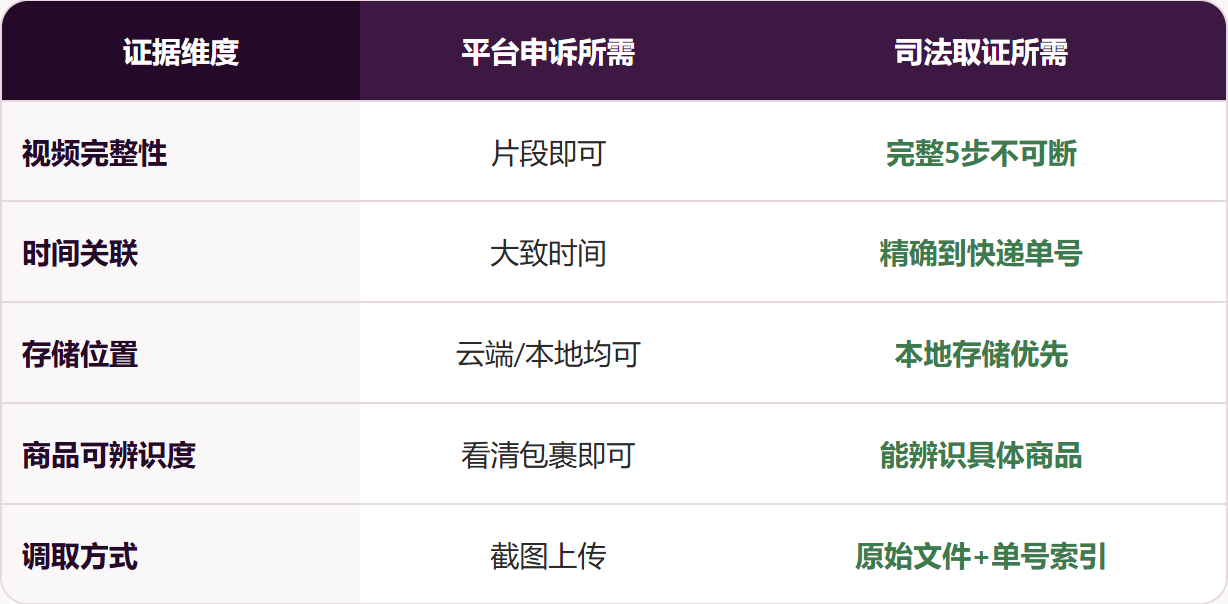
For a platform appeal, uploading a clip or screenshot may suffice. Legal discovery requires: a complete video from product display through carton sealing, indexed by tracking number, stored locally and unaltered. This is why professional sellers increasingly treat packing-monitoring as a full evidence-chain investment rather than a simple camera purchase.
4. How Sellers Can Build a Court-Ready Evidence Chain
The judicial turning point has arrived, but an incomplete evidence chain renders even the best precedent unusable. Sellers must embed evidence retention into their daily shipping workflow — not scramble for footage after the fact.
4.1 Five-Step Shipping Evidence SOP
inboz's shipping evidence SOP is five steps: product display → barcode binding to tracking number → accessory display → carton sealing and label application → archive. The full loop closes within 30 seconds.
Product display: Every primary item in the order is shown individually and clearly on camera, with the lens-to-product distance kept within the capture area.
Barcode binding: The system binds to the tracking number (not the order ID — the tracking number maps to the order, creating an indirect link). Scanning the barcode triggers the camera to begin recording.
Accessory display: Gifts, manuals, warranty cards, and all non-primary items are presented on camera.
Carton sealing and labeling: The full process of sealing the box and applying the shipping label is captured.
Archive: The system auto-files the recording by tracking number to local storage. For legal discovery, the original file is retrieved by tracking number.
Key design point: the monitoring system binds to the tracking number. This means every video can be directly indexed to its corresponding shipping record via the tracking number. In court, the seller provides the tracking number, the logistics company provides the signed-delivery record, and the two align — closing the evidence chain.
Important note: the recording process does not capture picking. Only the packing and shipping stage is recorded. Complete five-step videos have demonstrated, in real platform mediation cases, a dispute-resolution success rate more than three times higher than footage with missing steps. In legal discovery, completeness is a basic threshold requirement.
4.2 Storage: Local-First
inboz packing-monitoring uses local storage as the primary method (HDD/TF card). This is not a cost decision but a legal-discovery requirement. Local storage means data cannot be remotely tampered with, and the originality of the files is more likely to be accepted by the court. Cloud storage, while convenient for retrieval, can face challenges regarding "whether the files can be modified" during legal discovery.
5. Equipment Selection: A Legal-Discovery Perspective
From the standpoint of legal discovery, equipment selection must consider three dimensions: whether the capture area is large enough, whether the zoom mechanism can resolve product details, and whether the storage method meets evidentiary requirements.
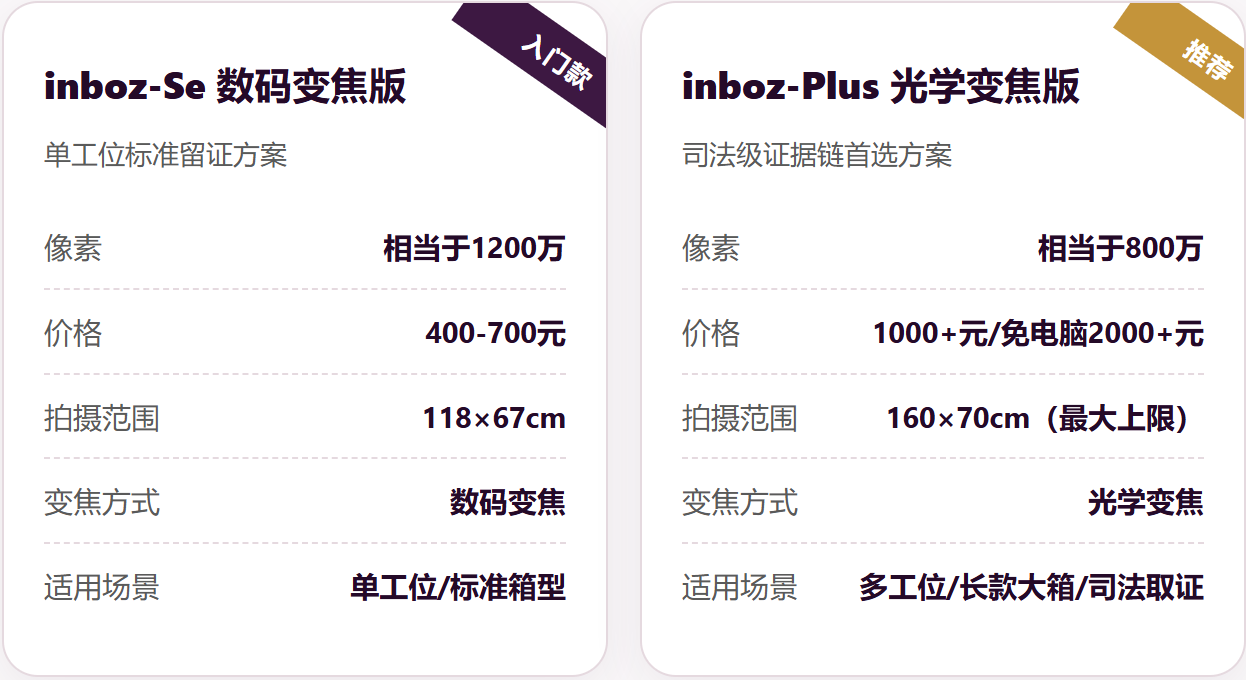
A note on 4K — frequently cited but misapplied. 4K is not recommended for the packing-monitoring category: file size balloons, storage fills fast, streams stutter. What determines evidence usability is the capture area and the zoom mechanism, not raw resolution. Optical zoom provides higher product identifiability in legal discovery than digital zoom, because optical zoom does not degrade image quality, whereas digital zoom progressively reduces effective resolution.
All shipping scenarios referenced in this article (jewelry boxes, shoe boxes, 3C accessory packaging, beauty packaging, etc.) fall within the inboz-Plus capture area of 160 × 70 cm. Items such as fishing rods, billiard cues, long down jackets, and office chairs are also within the Plus range. Products exceeding 160 cm require a separate assessment.
Selection Guidance
Below 5% return rate: inboz-Se (RMB 400–700, ~12 MP, 118 × 67 cm capture area) — standard-box single-station evidence.
5%–10% return rate: inboz-Plus PC-connected (RMB 1,000+, ~8 MP, 160 × 70 cm capture area) — optical zoom delivers higher product identifiability in legal discovery.
Above 10% return rate or high-risk categories: inboz-Plus PC-free kit (RMB 2,000+, integrated host, plug-and-play) — direct deployment for multi-station warehouses, eliminating per-station tuning.
6. Frequently Asked Questions
Q1: When encountering malicious refund-only abuse, should a seller file a platform appeal first or report to police first?
A: Do both simultaneously. The platform appeal targets fast interception of the refund; the police report lays the groundwork for judicial recourse. When reporting, bring the original shipping video file, tracking number, and delivery signature record. Cases supported by precedent have a higher practical chance of case acceptance.
Q2: What conditions must shipping video meet for legal discovery?
A: Three basic conditions: completeness (unbroken from product display through carton sealing), traceability (directly indexable by tracking number), and originality (locally stored, unmodified original file).
Q3: Is the difference between inboz-Se and inboz-Plus significant for legal discovery?
A: The core differences are the zoom mechanism and capture area. Se uses digital zoom with a 118 × 67 cm capture area, suited to standard-box formats. Plus uses optical zoom with a 160 × 70 cm capture area, better for long-form goods and scenarios requiring product detail identification. In legal discovery, optical zoom provides higher identifiability because it does not degrade image quality.
Q4: How long should packing recordings be retained?
A: A minimum of 3–6 months is recommended. For high-return categories or stores that have encountered professional refund-abuse scammers, extend to 12 months. The inboz system auto-archives by tracking number to local storage; retrieval typically completes in 1–3 seconds.
Q5: Which model is recommended for women's apparel / livestream fashion?
A: inboz-Plus is required. Women's apparel has high return rates and complex packaging forms (hangers, dust bags, hangtags — many details). Optical zoom and the 160 × 70 cm capture area ensure that details are clearly identifiable.
7. Summary
The true significance of the 2026 judicial turning point is not "the scammers got sentenced, sellers can relax." It is that the seller's rights-protection toolkit has gained a judicial weapon. Whether that weapon can be wielded, however, depends entirely on whether the evidence is hard enough — specifically, whether you have that 30-second complete shipping video.
The old seller recourse chain was: discover malicious refund → file platform appeal → appeal fails → absorb the loss. The chain now has an additional link: discover malicious refund → retrieve shipping video → report to police → court judgment. The chain has extended, but the prerequisite is a complete evidence chain.
We recommend that e-commerce sellers — especially those in high-return categories — treat packing-monitoring investment as an upgrade from "loss-prevention tool" to "judicial-discovery infrastructure." From the RMB 400–700 inboz-Se entry point, to the RMB 1,000+ Plus PC-connected, to the RMB 2,000+ PC-free kit, the selection logic is not about comparing prices — it is about matching your warehouse footprint, return structure, and legal-discovery requirements.