
Almost every seller hit by a malicious "refund-only" request has considered suing the buyer, yet few cases actually reach the courts. The hesitation usually comes down to two questions: how much will it cost, and can I actually win? This article breaks down the filing fees, full process, evidentiary standards and decision framework for small e-commerce lawsuits in China, so sellers can make a rational call once the anger settles.
1. Three Cost Items First: What a Small Claim Really Costs
Many sellers still picture litigation as a five-figure lawyer bill. The cost structure of a small e-commerce claim is very different.
Item one: court filing fees. For property-related cases where the amount in dispute is RMB 10,000 or less, the filing fee is RMB 50. Where the small-claim or simplified procedure applies, the fee is halved to RMB 25. Actual fee standards are subject to the latest guidance of the court's filing window.
Item two: time and effort. For orders worth a few hundred yuan, most sellers do not hire a lawyer and handle the process themselves: drafting the complaint, organizing evidence, filing the case, attending the hearing and waiting for judgment. A smooth case may close in one to two months; a complicated one may take three to five. For online sellers, this hidden cost often exceeds the filing fee itself.
Item three: enforcement uncertainty. Winning a judgment does not mean getting paid. The buyer is an individual whose personal assets are often limited. If the buyer refuses to pay after the judgment takes effect, the seller must apply for compulsory enforcement. Enforcement may succeed, or it may stall because the buyer genuinely has no executable assets. This is the most underestimated factor when weighing whether a suit is worthwhile.
In short, the financial threshold of a small claim is low; what truly deserves deliberation is the time investment and the enforcement outcome.
2. The Process in Five Steps
A small e-commerce lawsuit can be broken down into five steps, each with clear actions and requirements.
Step 1: Preserve the evidence. Before filing, get the evidence base in order: footage of the packing process, product information matching the order, platform handling records, and chat and payment-demand records with the buyer. Sellers using a traceability system can export all photos and timestamps for the order by its tracking number with one click, producing structured evidence; chat records should be archived as timestamped screenshots.
Step 2: Identify the defendant. A civil lawsuit requires a "clearly identified defendant," meaning the buyer's real name and identity details. Most e-commerce platforms support disclosure of the buyer's verified identity for litigation purposes; sellers may also apply for the court to obtain it after filing. Details are subject to platform rules and court requirements. This is where most lawsuits stall, so confirm it early.
Step 3: File online. Submit the complaint, evidence list and defendant information via the "People's Court Online Services" mini-program and choose the competent court. For smaller amounts, many courts apply the small-claim procedure, which is final at first instance and faster than the ordinary procedure. The amount thresholds differ by region; follow the court's latest guidance.
Step 4: Attend the hearing. Online or offline, present the evidence along a timeline: when the goods were shipped, what was shipped, what the buyer claims, and why the claim does not hold. The clearer the evidence is organized, the more efficient the hearing.
Step 5: Apply for enforcement. If the buyer fails to comply after the judgment takes effect, apply to the court for compulsory enforcement.
Steps 1 and 2 are the dividing line: with incomplete evidence or an unidentifiable defendant, the rest of the process cannot proceed.
3. What Really Determines the Outcome: Judges Rely on Evidence Chains, Not Stories
In small disputes, the winner is decided not by eloquence but by whether the evidence closes the factual loop. The core facts to prove in court, and the supporting evidence, are as follows:
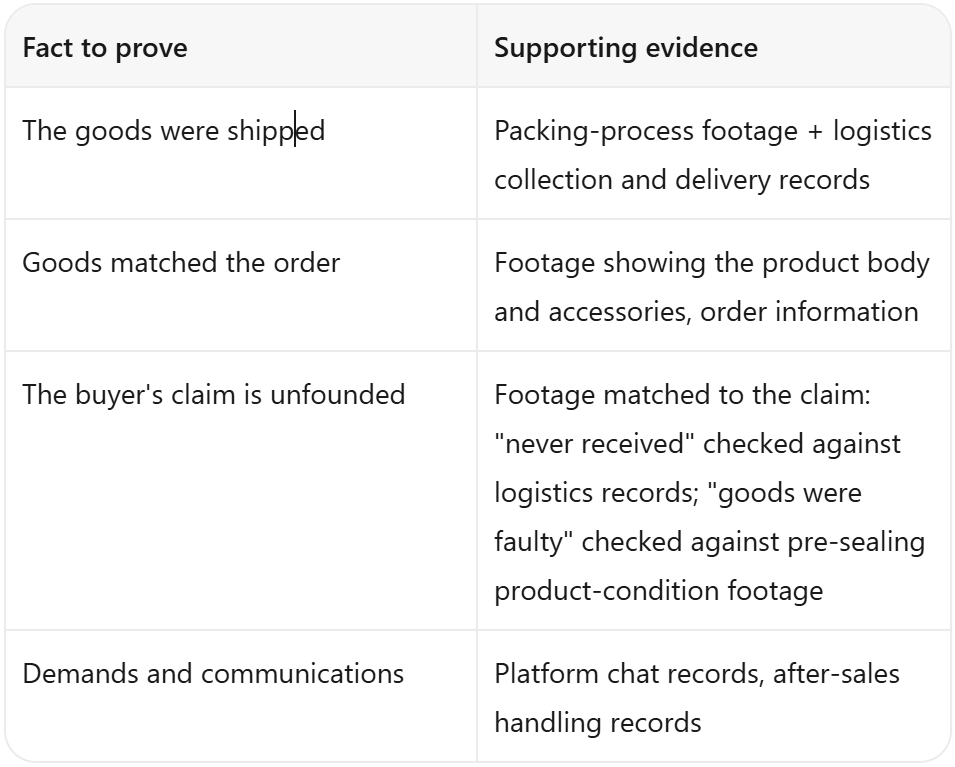
Only when these four pieces interlock into a closed loop does a win become well-founded; any missing link can become the other side's opening.
One battle-tested insight applies here: a screenshot package beats a full video. Judges, like platform reviewers, have no time to watch long videos. Key frames arranged along a timeline can be checked page by page during cross-examination — faster to review and far easier to accept.
Evidence must also survive long enough to be used: keep shipping records for at least 90 days to cover platform after-sales appeal windows, and 180 days or more for high-value categories such as jewelry and gold. With evidence archived by tracking number and retrievable in seconds, a seller can pull together all materials for one order half an hour before the hearing; sellers relying on ordinary CCTV must scrub through hours of footage instead.
4. A Decision Framework: Four Questions Before You Sue
Putting cost, process and odds together, ask yourself four questions before filing:
Order value. For disputes worth tens or a low hundreds of yuan, the time cost likely exceeds the recoverable amount, unless there are other considerations.
Evidence. If packing footage is incomplete or chat records are missing, shore up the evidence before talking about litigation.
Defendant. If the buyer's identity information cannot be obtained, the case cannot even be filed.
Deterrence. Against professional "refund-only" operators working in batches, a court judgment is worth more than the single case — with a precedent in hand, your leverage in future disputes of the same kind changes completely.
One more recommendation on sequence: exhaust the platform appeal first, then consider litigation. With complete appeal materials, platform intervention is far faster than judicial procedure; litigation should be reserved for problems the platform cannot solve. Nail the platform appeal, and most disputes never reach a court.
FAQ
Q: Do I need a lawyer for a small claim?
A: Small cases can be filed without one; the process is not complicated. For higher-value disputes, cases involving swap or authenticity issues, or when the other side hires counsel, consult a professional lawyer first.
Q: How do I obtain the buyer's real identity information?
A: First request identity disclosure from the platform for litigation purposes; if unavailable, apply for the court to obtain it after filing, subject to platform rules and court requirements.
Q: What if the buyer refuses to pay after the judgment?
A: Apply for compulsory enforcement. If the court finds no executable assets, it may conclude this round of enforcement; once assets are discovered later, enforcement can be resumed.
Conclusion
Suing a buyer is not an emotional decision but a rational calculation: filing fees start at RMB 50, halved under the small-claim procedure; the process takes five steps; the outcome hinges on whether the evidence chain closes; and whether it is worth it depends on order value and deterrence value.
For e-commerce sellers, the more valuable move is preventive: build shipping documentation into daily operations, keep evidence for at least 90 days (180 or more for high-value categories), and support one-click export of evidence packages by tracking number. With that foundation in place, the initiative stays with you — whether the dispute is resolved through a platform appeal or in court.
The inboz packing monitoring and e-commerce traceability solutions are built for e-commerce warehouse teams: automatic archiving by tracking number and one-click evidence-package export. For more information, visit inboz.cn or contact us to discuss your specific needs.