
1. How Platform Adjudication Actually Works
A platform intervention is not a debate—it is a standardized evidence review. The case handler knows neither party personally; the ruling rests solely on whose claims are better supported by the submitted materials.
All four platforms share the same underlying principle: the side whose claims are supported by evidence wins. The real differences lie in three variables:
Evidence window: how much time you have to submit proof. On Taobao/Tmall, after a buyer requests customer-service intervention, both parties typically have around 3 days to present evidence. Pinduoduo moves fast, and the window for supplementary evidence after a rejection is tighter. Douyin sets a clear evidence deadline, after which the case record closes. JD's process is standardized, with every node traceable.
Weight of evidence types: each platform weighs chat records, video footage and logistics data differently.
Default leaning: when evidence is ambiguous, the direction of discretion differs—Pinduoduo leans relatively more toward buyer experience.
Understanding these three variables is the prerequisite for winning a platform intervention: know the scoring rules before deciding where to invest effort.
2. Side-by-Side Comparison of the Four Platforms' Evidence Rules
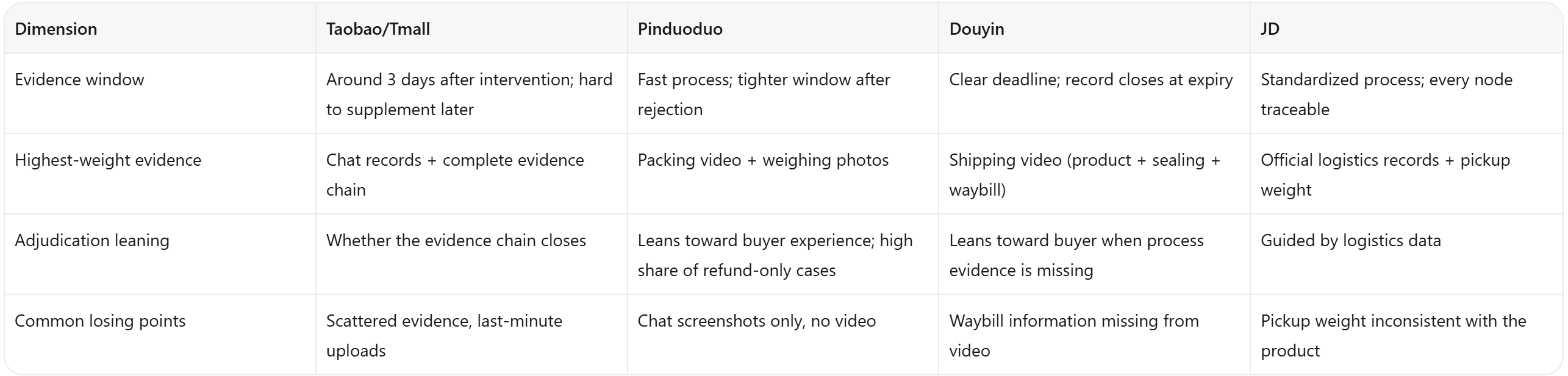
Note: platform rules are updated from time to time; always follow the current prompts in the seller backend. The table summarizes patterns that have remained relatively stable across long-term after-sales practice.
3. Platform-Specific Evidence Tips
Taobao/Tmall: It's All About a Closed Evidence Chain
The handler looks for mutual corroboration: chat records matching the order, shipping receipts matching the weight, certificates matching the product description. One broken link undermines the credibility of the entire chain. In practice, upload all evidence in one pass before requesting intervention—piecemeal uploads look poor and risk exceeding the evidence deadline.
Pinduoduo: The Goal Is to Refute "Not as Described" or "Empty Package"
On a platform with a high share of refund-only cases, chat screenshots carry very little weight. Packing videos and weighing photos—proof that the product was shipped as described with intact packaging—are the strongest cards when rejecting a buyer's claim. Evidence must address the exact point of dispute, not merely show the shipping process.
Douyin: Video Is the Main Battlefield
Douyin explicitly recognizes the evidentiary value of shipping videos. A qualified video should let the handler see three things in sequence: the product itself, the sealing process, and the waybill information. A video missing the waybill segment loses much of its force.
JD: Follow the Logistics Data
JD's logistics system forms a strong data loop, and disputes often hinge on weight. Retain weighing data at shipment and make sure the pickup record matches the actual product weight—this is far more persuasive than any written explanation.
4. Building a Cross-Platform Evidence Foundation
The platforms' rules differ, but their requirements for evidence quality are identical: clear, continuous and traceable. A cross-platform evidence foundation consists of five elements:
Display of product and accessories: confirm condition and completeness before shipping, with clear footage;
Tracking-number binding record: the link between the waybill number and the order is the starting point of all traceability;
Waybill information before sealing: recipient details must be legible—the element Douyin weighs most heavily;
Weighing data: for platforms like JD that follow logistics data;
Video archiving: searchable by tracking number and retrievable by time, ready the moment a dispute arises.
Evidence must exist at the moment of shipment—materials recorded or uploaded after the fact lose evidentiary strength. This is precisely the value of standardizing the warehouse evidence workflow.
5. Equipment Selection and Case Coverage Range
For warehouses handling high order volumes, ad-hoc phone footage cannot meet the requirements of being clear, continuous and traceable. Dedicated packing-monitoring equipment is recommended to make evidence capture a standard routine. inboz currently offers two devices with the following specifications:
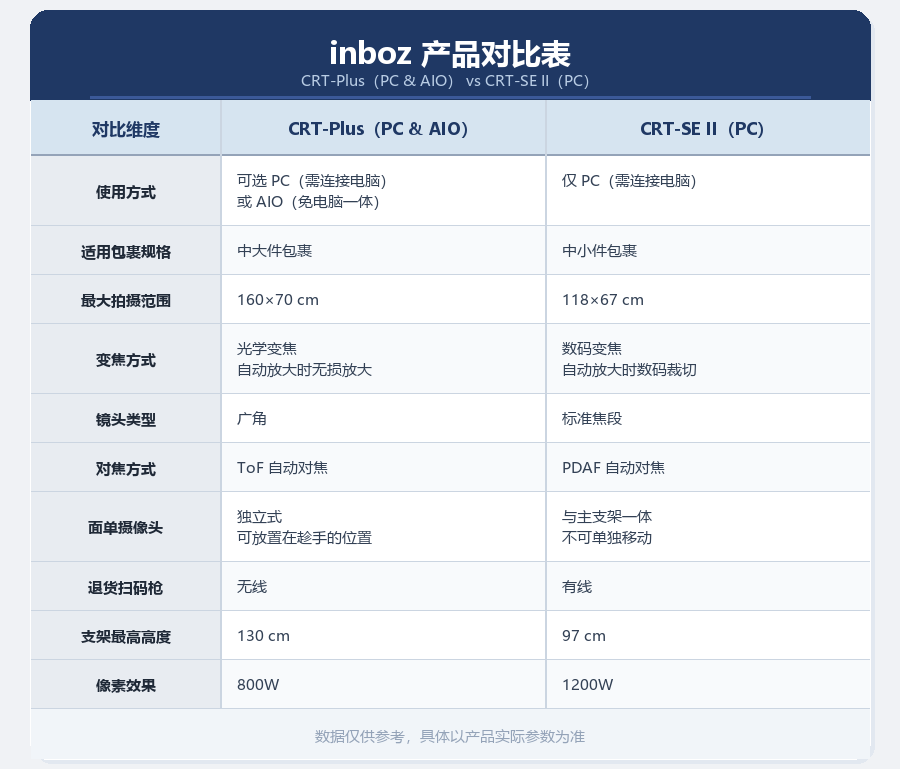
Selection guidance: for small, low-ticket categories (such as 3C accessories and cosmetic samples), the Se is sufficient; for high-ticket categories such as jewelry and footwear, choose the Plus—its wider coverage range and optical zoom keep details sharp when magnified, so labels and scratches hold up as evidence.
Regarding case coverage: common items on the packing table—shoe boxes, jewelry boxes, 3C accessories, long down jackets—all fall within the Plus's 160×70 cm coverage range; oversized items beyond that range (furniture, fitness equipment) are not suitable targets for packing-monitor evidence capture.
6. FAQ
Q1: Can evidence still be submitted after the window closes?
Most platforms stop accepting supplements once the window closes; in some cases one appeal is possible, but the success rate is far below that of a complete submission within the window. Submit everything in a concentrated pass as soon as you receive the notice.
Q2: Are chat records enough without a shipping video?
In some scenarios, yes—but for disputes over "not as described" or "empty packages," video evidence carries far more weight than text screenshots. For high-ticket categories, make video evidence standard.
Q3: Can the same evidence set be reused across all four platforms?
The evidence foundation is reusable, but the presentation order should be adapted per platform: organized as a chain for Taobao, highlighting video and weighing for Pinduoduo, complete three-element video for Douyin, and logistics alignment for JD.
Conclusion
The outcome of a platform intervention is seventy percent determined by evidence quality at the moment of shipment, and thirty percent by understanding each platform's rules. Rather than scrambling after a dispute arises, build your evidence structure to match platform rules, so that every order is fully documented.
To learn more about packing-monitoring solutions, visit the inboz website (inboz.cn) or contact us through official channels.